1,830 posters, 67 videos, 75 audios, 29 topics, 22 sessions, 4,727 authors, 1,697 institutions
ePostersLive by SciGen Technologies S.A. All rights reserved.
RCOG World Congress 2023
June 12 - 14, 2023 | London, UK

EP.0204
Adnexal torsion-Diagnostic challenges and outcomes from two tertiary units in UK.
Poster Presenter
Part of Topic
Benign Gynaecology
Adnexal torsion-Diagnostic challenges and outcomes from two tertiary units in UK
Authors: M Deniz1, M Lannon1, S Nakhare2, L Stoica2, B Cloke2, I Giarenis1
Norfolk and Norwich University Hospitals NHS Foundation Trust1; Guy’s and St Thomas’ NHS Foundation Trust2
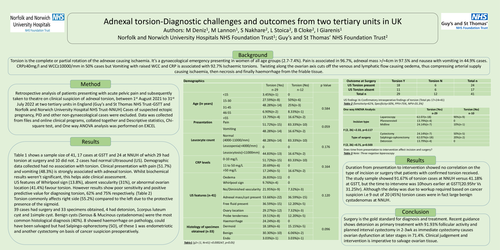
Background: Torsion is the complete or partial rotation of the adnexae causing ischaemia. It’s a gynaecological emergency presenting in women of all age groups (2.7-7.4%). Pain is associated in 96.7%, adnexal mass >/=4cm in 97.5% and nausea with vomiting in 44.9% cases. CRP≥40mg/l and WCC≥10000/mm in 50% cases but Vomiting with raised WCC and CRP is associated with 92.7% Ischaemic torsions. Twisting along the ovarian axis cuts off the venous and lymphatic flow causing oedema, thus compressing arterial supply causing ischaemia, then necrosis and finally haemorrhage from the friable tissue.
Method: Retrospective analysis of patients presenting with acute pelvic pain and subsequently taken to theatre on clinical suspicion of adnexal torsion, between 1st August 2021 to 31st July 2022 at two tertiary units in England (Guy’s and St Thomas NHS Trust-GSTT and Norfolk and Norwich University Hospital NHS Trust-NNUH) Cases of suspected ectopic pregnancy, PID and other non-gynaecological cases were excluded. Data was collected from files and online clinical programs, collated together and Descriptive statistics, Chi-square test, and One way ANOVA analysis was performed on EXCEL
Results: Table 1 shows a sample size of 41, 17 cases at GSTT and 24 at NNUH of which 29 had torsion at surgery and 10 did not. 2 cases had normal Ultrasound (US). Demographic data collected had no association with torsion. Clinical presentation with pain (51.7%) and vomiting (48.3%) is strongly associated with adnexal torsion. Whilst biochemical results weren’t significant, this helps aide clinical assessment.US features of Whirlpool sign (13.8%), absent vascularity (31%), or abnormal ovarian location (41.4%) favour torsion. However results show poor sensitivity and positive predictive value for diagnosing torsion, 62% and 75% respectively. (Table 2)Torsion commonly affects right side (55.2%) compared to the left due to the protective presence of the sigmoid.39 cases had surgery and 33 specimens obtained, 4 had detorsion, 1corpus luteum cyst and 1simple cyst. Benign cysts (Serous & Mucinous cystadenomas) were the most common histological diagnosis (40%). 8 showed haemorrhage on pathology, could have been salvaged but had Salpingo-ophorectomy (SO), of these 1 was endometriotic and another cystectomy on basis of cancer suspicion preoperatively.Duration from presentation to intervention showed no correlation on the type of incision or surgery that patients with confirmed torsion received. The study sample showed 91.67% of torsion cases at NNUH versus 41.18% at GSTT, but the time to intervene was 10hours earlier at GSTT(20.95hr Vs 31.25hr). Although the delay was due to workup required based on cancer suspicion i.e 9 out of 20 (45%) torsion cases were in fact large benign cystadenomas at NNUH.
Conclusion:Surgery is the gold standard for diagnosis and treatment. Recent guidance shows detorsion as primary treatment with 91.93% follicular activity and planned interval cystectomy in 2-3wk as immediate cystectomy causes ovarian dysfunction at later stages in 71.4%. Clinical judgement and intervention is imperative to salvage ovarian tissue.