1,830 posters, 67 videos, 75 audios, 29 topics, 22 sessions, 4,727 authors, 1,697 institutions
ePostersLive by SciGen Technologies S.A. All rights reserved.
RCOG World Congress 2023
June 12 - 14, 2023 | London, UK

EP.0200
A Rare Case Report of Bilateral Xanthogranulomatous Salpingo-Oophoritis
Poster Presenter
Part of Topic
Benign Gynaecology
Title
A Rare Case Report of Bilateral Xanthogranulomatous Salpingo-Oophoritis
Abstract
Objective
Xanthogranulomatous (XG) salpingo-oophoritis is a rare histopathological diagnosis of chronic inflammatory cell infiltrative processes within the genitourinary tract. The condition has symptomatology and radiological features mimicking ovarian malignancies or severe pelvic inflammatory disease (PID). The literature describes cases of XG diagnoses predominantly within the kidneys and gallbladder. In this report, we present a patient with bilateral xanthogranulomatous salpingo-oophoritis.
Case Report
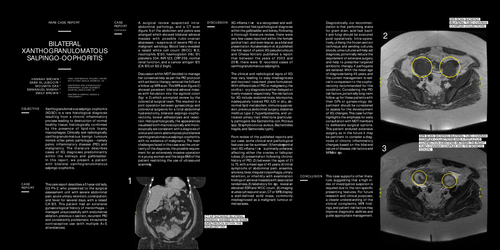
This case describes a 51-year-old lady presenting with severe abdominal pain, acute urinary retention, constipation, and fever. Surgical review suspected intra-abdominal pathology, so a computerised-tomography scan of abdomen and pelvis (CTAP) was arranged, demonstrating bilateral adnexal masses, with possible tubo-ovarian abscesses or malignancy. Following gynaecological MDT, a decision was made for conservative management as per PID protocol and removal of her intra-uterine system (IUS). A follow-up MRI showed persistent bilateral adnexal masses with fistulation into the sigmoid colon. She was reviewed with colorectal surgeons, resulting in a joint operation for total abdominal hysterectomy, bilateral salpingo-oophorectomy, bowel adhesiolysis and resection.
Discussion
The histological diagnosis of XG salpingo-oophoritis is a rare, benign form of chronic inflammation characterised by destruction then replacement of healthy tissue with inflammatory cells and lipid rich macrophages. The clinical and radiological signs may vary, leading to easy misdiagnoses, with the investigative process instead either following malignancy or severe PID pathways. With these differentials, the confirmatory diagnosis is either delayed or ‘overly-invasive’, in the case of PID and malignancy, respectively. The risk factors for XG include endometriosis, leiomyoma, PID, intrauterine device in situ and previous intra-abdominal surgery1,2. This case further highlights the emphasis for early consultation with MDT members to deliberate surgical options. This patient endured extensive surgery, so in the future it may be pertinent to consider a diagnosis of chronic inflammatory changes based on the bilateral nature of disease, risk factors and MRI findings.
Conclusion
This case supports other literature, suggesting that a high index of investigative suspicion is required due to the non-specific presenting features. For future research and clinical purposes, a clearer understanding of the clinical complaints, MRI findings, and patient risk factors may improve diagnostic abilities and guide appropriate management.
References:
1. Pang SY, et al (2016). Salpingo-Oophoritis Mimicking an Ovarian Malignancy: A Series of 3 Cases and Review of Literature. Obstet Gynecol Int J 5(3): 00162.
2. Elahi AA, Nigam A, et al (2015). Xanthogranulomatous oophoritis mimicking malignancy: a diagnostic dilemma. BMJ Case Report. doi: 10.1136/bcr-2015-210642
Categories (required)
Benign Gynaecology
Authors and Affiliations (required)
Miss Hannah Brown h.brown2@uea.ac.uk
Norwich Medical School-University of East Anglia, Norwich, United Kingdom
Dr emmanuel Mama davibob07@gmail.com
Ipswich Hospital, Ipswich, United Kingdom
Dr Moumita Das moumita.das@qehkl.nhs.uk
Queen Elizabeth Hospital King's Lynn, King's Lynn, United Kingdom
Miss Saba Al-Juboori (Presenting) saba.aljuboori@doctors.org.uk
Queen Elizabeth Hospital King's Lynn, King's Lynn, United Kingdom