1,830 posters, 67 videos, 75 audios, 29 topics, 22 sessions, 4,727 authors, 1,697 institutions
ePostersLive by SciGen Technologies S.A. All rights reserved.
RCOG World Congress 2023
June 12 - 14, 2023 | London, UK

EP.0194
Menstrual cycles and impact upon performance in elite athletes; a longitudinal study
Poster Presenter
Authors
Benjamin Jones, Ariadne L'Heveder, Charlotte Bishop, Sarah Davies, Robin Chakraverty, James Brown, Noel Pollock
Affiliations
Hammersmith Hospital, Imperial College NHS Trust, University College London Hospital, West Middlesex University Hospital, Institute of Sport, Exercise and Health, University College London, British Athletics, National Performance Institute
Part of Topic
Benign Gynaecology
Objective: To assess for menstrual disorders and the effect of menstrual cycles upon performance in elite British track and field athletes.
Design: A longitudinal survey
Setting: United Kingdom (UK)
Population: Elite track and field athletes at British Athletics
Methods: A questionnaire was sent to participants every 6 months, over a five-year period between 1st October 2014 and 1st October 2019. The questions assessed details about their menstrual cycles and premenstrual symptoms, as well as their perception of the impact of these on athletic performance.
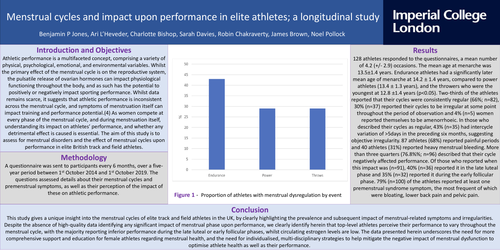
Results: 128 athletes responded to the questionnaires, a mean number of 4.2 (+/- 2.9) occasions. The mean age at menarche was 13.5±1.4 years.Endurance athletes had a significantly later mean age of menarche at 14.2 ± 1.4 years, compared to power athletes who had a mean of 13.4 ± 1.3years, and the throwers whowere the youngest at 12.8 ±1.4 years (p<0.05).Two-thirds of the athletes reported that their cycles were consistently regular (66%; n=82), 30% (n=37) reported their cycles to be irregular at some point throughout the period of observation and 4% (n=5) women reported themselves to be amenorrhoeic. In those who described their cycles as regular, 43% (n=35) had intercycle variation of >5days in the preceding six months, suggesting objective irregularity. 87 athletes (68%) reported painful periods and 40 athletes (31%) reported heavy menstrual bleeding. More than three quarters (76.8%%; n=96)described that their cycle negatively affected performance. Of those who reported when this impact was (n=91), 40% (n=36) reported it in the late luteal phase and 35% (n=32) reported it during the early follicular phase. 79% (n=100) of the athletes reported at least one premenstrual syndrome symptom, the most frequent of which were bloating, lower back pain and pelvic pain.
Conclusions: Our data highlights the complex interrelationship between gynaecological health and elite athletic performance. Elite athletes experience later menarche than the general population and exhibit a higher degree of menstrual irregularity. We clearly demonstratethat athletes perceive a negative impact from their menstrual cycles upon performance, and a desire to help manage these more effectively, particularly during competition. This data suggests an important role for gynaecological expertise in the multi-disciplinary management of these women.