1,830 posters, 67 videos, 75 audios, 29 topics, 22 sessions, 4,727 authors, 1,697 institutions
ePostersLive by SciGen Technologies S.A. All rights reserved.
RCOG World Congress 2023
June 12 - 14, 2023 | London, UK

EP.0190
Gestational Diabetes: Diet or Medication?
Poster Presenter
Authors
SHAHAD Mahmoud Hussein, Rawaa Ouda, Aliaa Maher Al Chaar, Hala Marwan Safadi, Salman Mohamad Salman, Ibrahim Mohammed, Iman Gaafar Younis, Reem Mohamed Mohyeldin, Dima Ribhi Jarrar, Saira Aatif Riaz
Affiliations
Shaikh Shakhbout Medical City, Gulf Medical University, Mediclinic Airport Road Hospital
Part of Topic
High Risk Pregnancy
Objective: To study the effect of diet control in women with Gestational Diabetes Mellitus (GDM) on pregnancy and pregnancy outcomes, and the need for glucose control medication, in a single Emirati hospital.
Design: Hospital based retrospective descriptive study
Method: Data were collected manually from electronic medical records in the period 1-10-2020 to 31-3-2021. All women who delivered in our hospital in the study period, and were diagnosed with GDM were included. The study group was classified into 4 categories: GDM controlled with diet only, GDM controlled with diet and needed medication, GDM not on diet and needed no medication, and GDM not on diet but needed medication. Medication to control blood sugar is either metformin, insulin, or both. Study variables were; need for medication, duration of pregnancy, induction of labour (IOL), polyhydramnios, shoulder dystocia, and fetal weight on delivery. Demographic characteristics of the study group was described. Data were entered in Excel sheets and described in numbers and percentages.
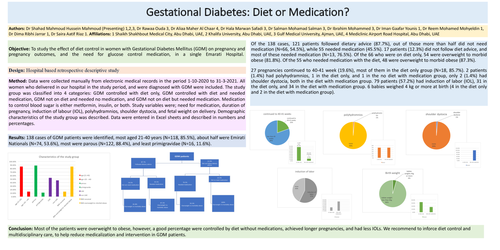
Results: 138 cases of GDM patients were identified, most aged 21-40 years (N=118, 85.5%), about half were Emirati Nationals (N=74, 53.6%), most were parous (N=122, 88.4%), and least primigravidae (N=16, 11.6%). Of the 138 cases, 121 patients followed dietary advice (87.7%), out of those more than half did not need medication (N=66, 54.5%), while 55 needed medication (45.5%). 17 patients (12.3%) did not follow diet advice, and most of these needed medication (N=13, 76.5%). Of the 66 who were on diet only, 54 were overweight to morbid obese (81.8%). Of the 55 who needed medication with the diet, 48 were overweight to morbid obese (87.3%). 27 pregnancies continued to 40-41 week (19.6%), most of them in the diet only group (N=18, 85.7%). 2 patients (1.4%) had polyhydramnios, 1 in the diet only, and 1 in the no diet with medication group, only 2 (1.4%) had shoulder dystocia, both in the diet with medication group. 79 patients (57.2%) had induction of labor (IOL), 31 in the diet only, and 34 in the diet with medication group. 6 babies weighed 4 kg or more at birth (4 in the diet only and 2 in the diet with medication group).
Conclusion: Most of the patients were overweight to obese, however, a good percentage were controlled by diet without medications, achieved longer pregnancies, and had less IOLs. We recommend to inforce diet control and multidisciplinary care, to help reduce medicalization and intervention in GDM patients.