1,830 posters, 67 videos, 75 audios, 29 topics, 22 sessions, 4,727 authors, 1,697 institutions
ePostersLive by SciGen Technologies S.A. All rights reserved.
RCOG World Congress 2023
June 12 - 14, 2023 | London, UK

PP.0232
Spontaneous Ureteric Rupture: A Rare Case Identified Following Spontaneous Vaginal Delivery
Poster Presenter
Part of Topic
Labour Ward Management
BACKGROUND
¨ Spontaneous ureteric rupture is an extremely rare cause of sudden onset abdominal pain in the peripartum period
¨ The majority of previously reported cases in peripartum have either been in women who have either undergone instrumental delivery or are attempting vaginal birth after caesarean section (VBAC)
¨ Spontaneous ureteric rupture is defined as extravasation of urine from the ureter which occurs without trauma or iatrogenic manipulation of the ureter 1
CASE
¨ 34 year old para 1 (previous SVD) with no background medical or surgical history.
¨ Booked under consultant led care after uterine artery dopplers were not able to be measured at the 20 week anomaly scan and low papp-a.
¨ Normal growth scans during pregnancy with EFW of 4037g at 41+5.
¨ Declined IOL until 42+2 when she presented following spontaneous rupture of members.
¨ She had a spontaneous vaginal delivery 13 hours after established labour commenced
¨ Four hours post delivery she developed sudden onset severe abdominal pain
¨ She underwent a CT abdomen pelvis which identified significant ascites and thereafter had an ascitic tap performed by the medical team
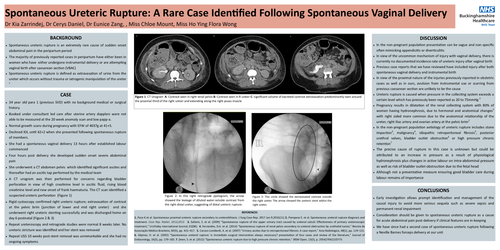
¨ A CT urogram was then performed for concerns regarding bladder perforation in view of high creatinine level in ascitic fluid, rising blood creatinine level and new onset of frank haematuria. The CT scan identified a suspected ureteric perforation (Figure 1)
¨ Rigid cystoscopy confirmed right ureteric rupture; extravasation of contrast at the pelvic brim (junction of lower and mid right ureter) and she underwent right ureteric stenting successfully and was discharged home on day 6 postnatal (Figure 2 & 3)
¨ Repeat ureteroscopy and retrograde studies were normal 8 weeks later. No ureteric stricture was identified and her stent was removed
¨ Repeat USS 10 weeks post-stent removal was unremarkable and she had no ongoing symptoms
DISCUSSION
¨ In the non-pregnant population presentation can be vague and non-specific often mimicking appendicitis or diverticulitis
¨ In view of the uncommon mechanism of injury with vaginal delivery, there is currently no documented incidence rate of ureteric injury after vaginal birth
¨ Previous case reports that we have reviewed have included injury after both spontaneous vaginal delivery and instrumental birth
¨ In view of the proximal nature of the injuries previously reported in obstetric cases as well as in ours, avulsion from instrumental use or scarring from previous caesarean section are unlikely to be the cause
¨ Ureteric rupture is caused when pressure in the collecting system exceeds a certain level which has previously been reported as 20 to 75mmHg 2
¨ Pregnancy results in dilatation of the renal collecting system with 80% of women having hydronephrosis, due to hormonal and anatomical changes2 with right sided more common due to the anatomical relationship of the ureter, right iliac artery and ovarian artery at the pelvic brim2
¨ In the non-pregnant population aetiology of ureteric rupture includes stone impaction3, malignancy4, idiopathic retroperitoneal fibrosis5, posterior urethral valves, bladder outlet obstruction6 or high pressure chronic retention7
¨ The precise cause of rupture in this case is unknown but could be attributed to an increase in pressure as a result of physiological hydronephrosis plus changes in active labour on intra-abdominal pressure as well as risk of bladder outlet obstruction due to the fetal head
¨ Although not a preventative measure ensuring good bladder care during labour remains of importance
CONCLUSIONS
¨ Early investigation allows prompt identification and management of the causal injury to avoid more serious sequela such as severe sepsis and permanent renal impairment
¨ Consideration should be given to spontaneous ureteric rupture as a cause for acute abdominal pain post-delivery if clinical features are in-keeping
¨ We have since had a second case of spontaneous ureteric rupture following a Neville Barnes forceps delivery at our unit
REFERENCES
1. Pace K et al. Spontaneous proximal ureteric rupture secondary to ureterolithiasis. J Surg Case Rep. 2017 Jan 9;2016(11) 2. Pampana E. et al. Spontaneous ureteral rupture diagnosis and treatment. Case Rep. Radiol. 2013;2013 3. Sallami, S. et al. (2009) “Spontaneous rupture of the upper urinary tract caused by ureteral calculi: Effectiveness of primary ureteroscopic treatment,” UroToday International Journal, 02(06). 4. Fernandes, D.A. et al. (2014) “Spontaneous rupture of renal pelvis secondary to ureteral obstruction by urothelial tumor,” Revista da Associação Médica Brasileira, 60(5), pp. 415–417. 5. Caruso-Lombardi, A. et al. (2007) “Urinary ascites due to retroperitoneal fibrosis: A case report,” Acta Radiologica, 48(1), pp. 119–121. 6. Akpinar, H. et al. (2002) “Spontaneous ureteral rupture: Is immediate surgical intervention always necessary? presentation of four cases and review of the literature,” Journal of Endourology, 16(3), pp. 179–183. 7 .Deen, S. et al. (2022) “Spontaneous ureteric rupture due to high pressure chronic retention,” JRSM Open, 13(3), p. 205427042210775