1,830 posters, 67 videos, 75 audios, 29 topics, 22 sessions, 4,727 authors, 1,697 institutions
ePostersLive by SciGen Technologies S.A. All rights reserved.
RCOG World Congress 2023
June 12 - 14, 2023 | London, UK

PP.0228
Extensive Necrotizing Fasciitis from Vulva to Umbilicus – A long roller coaster journey
Poster Presenter
Authors
Affiliations
Part of Topic
Benign Gynaecology
Audio
Extensive necrotizing fasciitis of Vulva to anterior abdominal wall- A long roller coaster journey
Case presentation
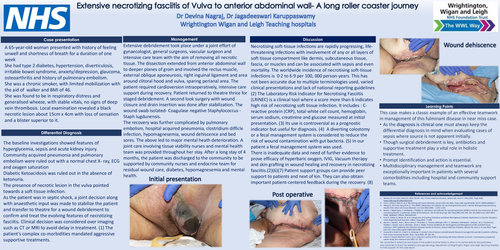
A 65-year-old woman presented with history of feeling unwell and shortness of breath for a week and noticing a lump in the vulval area.
She had type 2 diabetes, hypertension, diverticulosis, irritable bowel syndrome, anxiety and depression, glaucoma, osteoarthritis and history of pulmonary embolism.
She was a chronic smoker, limited mobilization with walker and BMI of 46.
She was vitally stable, with some respiratory distress and generalised wheeze, no signs of deep vein thrombosis and with suprapubic tenderness.
Local examination revealed a black necrotic lesion about 15cm x 4cm with loss of sensation and a blister superior to it.
Differential diagnosis
The baseline investigation showed features of deranged sugars, sepsis, acute kidney injury.
Community acquired pneumonia and pulmonary embolism was ruled out by a normal chest X- ray, normal ECG and oxygen saturation of 98% on room air
Diabetic Ketoacidosis was ruled out as no ketonuria.
The presence of necrotic lesion in the vulva pointed towards a soft tissue infection.
As the patient was in septic shock, a joint decision along with anaesthetic input was made to stabilize the patient and transfer to theatre for a wound debridement to confirm and treat the evolving features of necrotizing fasciitis. Clinical judgment is considered the vital diagnostic tool for necrotizing fasciitis and CT or MRI might have delayed definitive diagnosis and treatment especially in case of septic shock. (1) The patient’s complex co-morbidities mandated aggressive supportive treatments
Management
Extensive debridement took place under a joint effort of gynaecologist, general surgeons, vascular surgeon and intensive care team with the aim of removing all necrotic tissue. The dissection extended from anterior abdominal wall to deeper planes of groin and involved the rectus muscle, external oblique aponeurosis, right inguinal ligament, area around clitoral hood and vulva sparing perianal area. The patient required cardioversion intraoperatively, intensive care support during recovery and also broad spectrum antibiotics and blood products. Patient returned to theatre thrice for staged debridement. A second look surgery with wound closure and drain insertion was done after stabilization. The wound swab isolated- Coagulase negative Staphylococcus - Staph lugdunensis.
The patient had a turbulent recovery affected by pulmonary embolism, hospital acquired pneumonia, clostridium difficle infection, hypomagnesemia and major mental heath deterioration. She developed bed sores and wound dehiscence. There was involvement of the tissue viability team, healing by secondary intention and support from mental health team.
After long stay of 4 months, the patient was discharged to the community where she was under the care of community nurses and endocrine team for residual wound care, diabetes and hypomagnesemia, and also mental health support groups.
Discussion
Necrotising soft-tissue infections are rapidly progressing, life-threatening infections with involvement of any or all layers of soft tissue compartment like dermis, subcutaneous tissue, fascia, or muscles and can be associated with sepsis and even mortality. The worldwide incidence of necrotising soft-tissue infections is 0∙2 to 6∙9 per 100, 000 person-years. This has not been accurate due to multiple terminologies used, varied clinical presentations and lack of national reporting guidelines (2) The Laboratory Risk Indicator for Necrotising Fasciitis (LRINEC) is a clinical tool where a score more than 6 indicates high risk of necrotizing soft tissue infection. It includes: C-reactive protein (CRP), total white cell count, hemoglobin, serum sodium, creatinine and glucose measured at initial presentation. (3) Its use is controversial as a prognostic indicator but is useful for diagnosis. (4) A diverting colostomy or a fecal management system is considered to reduce the risk of wound contamination with gut bacteria. (5) In our patient a fecal management system was used.
There is inadequate data and need for further evidence to prove efficacy of hyperbaric oxygen, IVIG, vacuum therapy and skin grafting in wound healing and recovery in cases of necrotizing fasciitis.(2)(6)(7) Patient support groups can provide peer support to patients and next of kin. They can also obtain important patient-centered feedback during the recovery. (8)
Learning points
This case makes a classic example of an effective team work in management of this fulminant disease in a near miss case.
We would like to extend sincere thanks to the patient and her family to allow us to use the data for this publication.
Also would like to thank the obstetrics and gynaecology department at Wrightington Wigan and Leigh teaching hospitals for their support for this case report.
We would like to extend sincere thanks to the patient and her family to allow us to use the data for this publication.
Also would like to thank the obstetrics and gynaecology department at Wrightington Wigan and Leigh teaching hospitals for their support for this case report.