1,830 posters, 67 videos, 75 audios, 29 topics, 22 sessions, 4,727 authors, 1,697 institutions
ePostersLive by SciGen Technologies S.A. All rights reserved.
RCOG World Congress 2023
June 12 - 14, 2023 | London, UK

PP.0226
One-stop facility model, localizing WHO Comprehensive Abortion Care Guidelines in Uganda.
Poster Presenter
Part of Topic
Abortion Care
Audio
CASE REPORT, PP0226: Peer learning, community outreach, male champions and a one-stop facility model, localizing WHO Comprehensive Abortion Care Guidelines: a holistic approach to prevent unsafe abortions and increase uptake of post abortion care in Uganda.
Author(s) Wasswa Henry-hwasswa@rhu.or.ug ; Annet Kyarimpa-akyarimpa@rhu.or.ug (Reproductive Health Uganda); Ekman Carolin - ekmanc=who.int@groups.ibpnetwork.org (WHO Department of Sexual and Reproductive Health and Research (SRH)
BACKGROUND AND CONTEXT
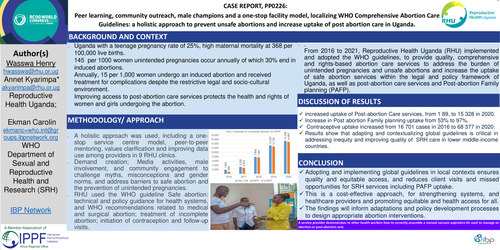
Uganda with a teenage pregnancy rate of 25%, (below age of 19 years), is burdened with the high maternal mortality at 368 per 100,000 live births. On average, 145 per 1000 women unintended pregnancies occur annually of which 30% end in induced abortions. Annually, 15 per 1,000 women of reproductive age undergo an induced abortion and received treatment for complications despite the restrictive legal and socio-cultural environment. Improving access to post-abortion care services protects the health and rights of women and girls undergoing the abortion. From 2016 to 2021, RHU implemented an initiative adopting the WHO guidelines, to provide quality, comprehensive and rights-based abortion care services to address the burden of unintended pregnancies and unsafe abortions by increasing the uptake of safe abortion services within the legal and policy framework of Uganda, as well as post-abortion care services and Post-abortion Family planning (PAFP).
“I took my friend to the hospital because she was very weak, but we were not helped. My friend told the health workers that the bleeding started after she put certain pills under the tongue as she had been instructed at the pharmacy. The health workers said it was a criminal abortion and threatened to involve authorities and have us write statements at the police. Luckily, we found a way to sneak out of the hospital. Another friend of mine told us to go to RHU to get metronidazole to stop the vomiting.” Client at RHU clinic
The initiative took on a holistic approach, including a one-stop service centre model, peer-to-peer mentoring, values clarification and improving data use among providers in the nine RHU clinics. The project also entailed media activities, male involvement, and community engagement to challenge myths, misconceptions and gender norms, which put women at risk of violence; and pose barriers to safe abortion and the prevention of unintended pregnancies. In order to design and implement effective interventions, RHU used a range of evidence-based resources on abortion care, including WHO guidelines that include technical and policy recommendations, such as Safe abortion, medical and surgical abortion; treatment of incomplete abortion; initiation of contraception and follow-up visits: technical and policy guidance for health systems (2012) and Health worker roles in providing safe abortion care and post-abortion contraception (2015); and the WHO Medical eligibility criteria for contraceptive use (MEC); as well as other PAFP resources from WHO partner organizations. These resources were selected as they are evidence-based sources, that address reproductive health needs of women and provide guidance on how health care providers can deliver quality post-abortion care, including family planning.
Discussion:
The monthly reports from RHU clinics show that following the introduction of sensitization activities in the communities, there has been an increase in the number of women visiting RHU clinics for PAC services. In four years, the amount of women visiting RHU to receive care for missed abortion, incomplete abortion, or complications from unsafe abortion, increased by more than seven times, from 1 894 visits in 2016, to 15 328 visits in 2020. Of out these clients, there was also a dramatic increase in uptake of PAFP information and counselling . In 2016, only half of the women (53%) chose to receive PAFP services. Just two years later, in 2018, virtually all PAC clients (97%) took up PAC services, and this figure was maintained during 2019 and 2020. This means that almost 14 times as many women received PAFP in RHU clinics, compared to in 2016. Uptake of contraceptives more than quadrupled, from 16 701 cases in 2016, to 68 377 in 2020. These results show that adapting and contextualizing global guidelines is critical in addressing inequity and improving quality of SRH care in lower middle-income countries.
Conclusions:
Adopting and implementing global guidelines in local contexts ensures quality and equitable access, and reduces client visits and missed opportunities for Sexual Reproductive health services including PAFP uptake. This is a cost-effective approach, for strengthening systems, and healthcare providers and promoting equitable and health access for all. The findings will inform adaptations and policy development processes to design appropriate abortion interventions.