1,830 posters, 67 videos, 75 audios, 29 topics, 22 sessions, 4,727 authors, 1,697 institutions
ePostersLive by SciGen Technologies S.A. All rights reserved.
RCOG World Congress 2023
June 12 - 14, 2023 | London, UK

PP.0219
An Ovarian Teratoma-Induced Anti-NMDAR Encephalitis in a Teenage Filipino Girl
Poster Presenter
Part of Topic
Adolescent Gynaecology
AN OVARIAN TERATOMA-INDUCED ANTI-NMDAR ENCEPHALITIS IN A TEENAGE FILIPINO GIRL
Interesting Case Report
CHERYL ADELINE TUAZON-CALDA, MD MARK Q. ANTONIO, MD, FPOGS, FSGOP
ANGELES UNIVERSITY FOUNDATION MEDICAL CENTER, PAMPANGA, PHILIPPINES
INTRODUCTION
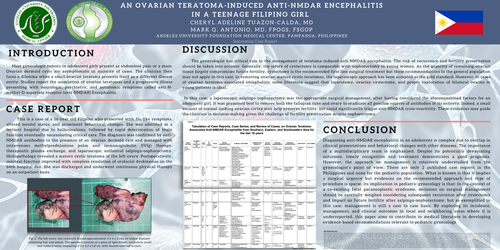
Most gynecologic tumors in adolescent girls present as abdominal pain or a mass. Ovarian dermoid cysts are asymptomatic in majority of cases. The clinician then faces a dilemma when a small ovarian teratoma presents itself as a different disease entity. Studies report the association of ovarian teratomas and a progressive illness presenting with neurologic, psychiatric, and autonomic symptoms called anti-Nmethyl-D-aspartate receptor (anti-NMDAR) Encephalitis.
CASE REPORT
This is a case of a 16-year old Filipino who presented with flu-like symptoms, altered mental status, and prominent behavioral changes. She was admitted at a tertiary hospital due to hallucinations, followed by rapid deterioration of brain function eventually necessitating critical care. The diagnosis was confirmed by antiNMDAR antibodies in the presence of an ovarian dermoid cyst and managed with intravenous methylprednisolone pulse and immunoglobulin (IVIg) therapy, therapeutic plasma exchange, and laparoscopic unilateral salpingo-oophorectomy. Histopathology revealed a mature cystic teratoma of the left ovary. Postoperatively, cerebral function improved with complete resolution of orofacial dyskinesias on the 64th hospital day. She was discharged and underwent continuous physical therapy on an outpatient basis.
DISCUSSION
The gynecologist has critical role in the management of teratoma-induced anti-NMDAR encephalitis. The risk of recurrence and fertility preservation should be taken into account. Generally, the safety of cystectomy is comparable with oophorectomy in young women. As the quantity of remaining ovarian tissue largely compromises future fertility, cystectomy is the recommended first line surgical treatment but these recommendations in the general population may not apply in this case. In removing ovarian mature cystic teratomas, the laparoscopic approach has been accepted as the gold standard. However, in cases of ovarian teratoma-associated encephalitis, some literature suggest that laparotomy, ovarian cystectomy, and proper exploration of bilateral ovaries in young patients is ideal. In this case, a laparoscopic salpingo-oophorectomy was the appropriate surgical management, after having considered the aforementioned factors for an adolescent girl. It was presumed best to remove both the fallopian tube and ovary to eradicate all possible sources of antibodies in its entirety. Indeed, a small amount of normal-looking ovarian cortex may help preserve fertility, but could significantly trigger anti-NMDAR cross-reactivity. These evidences may guide the clinician in decision-making given the challenge of fertility preservation despite oophorectomy.
CONCLUSION
Diagnosing anti-NMDAR encephalitis in an adolescent is complex due to overlap in clinical presentations and behavioral changes with other diseases. The importance of a multidisciplinary team is emphasized. Despite its potentially devastating outcomes, timely recognition and treatment demonstrates a good prognosis. However, the approach on management is relatively understudied from the gynecologist’s point of view. There are only 2 published case reports in the Philippines and none for the pediatric population. What is known is that it implies a surgical urgency but evidences on the recommended approach and type of procedure is sparse. Its implication in pediatric gynecology is that: In the context of a co-existing fatal paraneoplastic syndrome, decisions on surgical management should be carefully weighed considering subsequent recurrence after cystectomy and impact on future fertility after salpingo-oophorectomy, but as exemplified in this case, management is still a case to case basis. By exploring its incidence, management, and clinical outcomes in local and neighboring areas where it is underreported, this paper aims to contribute to medical literature in developing evidence-based recommendations relevant to pediatric gynecology.