1,830 posters, 67 videos, 75 audios, 29 topics, 22 sessions, 4,727 authors, 1,697 institutions
ePostersLive by SciGen Technologies S.A. All rights reserved.
RCOG World Congress 2023
June 12 - 14, 2023 | London, UK

PP.0218
Mayer-Rokitansky-Kuster-Hauser Syndrome Complicated With Giant Mucinous Cystadenoma and Inguinal Herniation: Case Report
Poster Presenter
Part of Topic
Adolescent Gynaecology
Mayer-Rokitansky-Kuster-Hauser Syndrome Complicated With Giant Mucinous Cystadenoma and Inguinal Herniation: Case Report
Anita Rachmawati ; Artha Falentin Putri Susilo ; Alfonsus Zeus Suryawan ; Kevin Dominique Tjandraprawira
Introduction
Mayer-Rokitansky-Kuster-Hauser (MRKH) syndrome is congenital disorder which includes vaginal agenesis accompanied with variable mullerian ducts anomalies and sometime accompanied by renal, skeletal, or auditory abnormalities. Coexisting of MRKH with other condition are rare findings, especially when MRKH was found in young woman present with ovarian malignancy.
Case Report
A 22-year-old woman complaining of primary amenorrhea and abdominal mass. The patient was Tanner stage 3 for pubic hair and Tanner stage 4 for breast.
Abdominal examination revealed cystic mass of 25 x 25 x 20 cm. Vagina was 1 cm in length. Bilateral inguinal hernia was also present
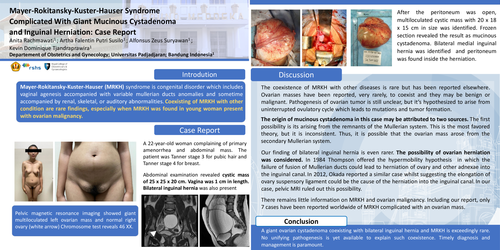
Pelvic magnetic resonance imaging showed giant multiloculated left ovarian mass and normal right ovary (white arrow) Chromosome test reveals 46 XX.
After the peritoneum was open, multiloculated cystic mass with 20 x 18 x 15 cm in size was identified. Frozen section revealed the result as mucinous cystadenoma. Bilateral medial inguinal hernia was identified and peritoneum was found inside the herniation.
Discussion
The coexistence of MRKH with other diseases is rare but has been reported elsewhere. Ovarian masses have been reported, very rarely, to coexist and they may be benign or malignant. Pathogenesis of ovarian tumor is still unclear, but it’s hypothesized to arise from uninterrupted ovulatory cycle which leads to mutations and tumor formation.
The origin of mucinous cystadenoma in this case may be attributed to two sources. The first possibility is its arising from the remnants of the Mullerian system. This is the most favored theory, but it is inconsistent. Thus, it is possible that the ovarian mass arose from the secondary Mullerian system.
Our finding of bilateral inguinal hernia is even rarer. The possibility of ovarian herniation was considered. In 1984 Thompson offered the hypermobility hypothesis in which the failure of fusion of Mullerian ducts could lead to herniation of ovary and other adnexae into the inguinal canal. In 2012, Okada reported a similar case whilst suggesting the elongation of ovary suspensory ligament could be the cause of the herniation into the inguinal canal. In our case, pelvic MRI ruled out this possibility.
There remains little information on MRKH and ovarian malignancy. Including our report, only 7 cases have been reported worldwide of MRKH complicated with an ovarian mass.
Conclusion
A giant ovarian cystadenoma coexisting with bilateral inguinal hernia and MRKH is exceedingly rare. No unifying pathogenesis is yet available to explain such coexistence. Timely diagnosis and management is paramount.