1,830 posters, 67 videos, 75 audios, 29 topics, 22 sessions, 4,727 authors, 1,697 institutions
ePostersLive by SciGen Technologies S.A. All rights reserved.
RCOG World Congress 2023
June 12 - 14, 2023 | London, UK

PP.0216
REFLEX ANURIA:A RARE CAUSE OF ACUTE RENAL FAILURE
Poster Presenter
Authors
Affiliations
Part of Topic
Benign Gynaecology
OBJECTIVE
Reflex anuria (RA) is a rare cause of postoperative anuria that can lead to acute renal failure(ARF). Bilateral prophylactic ureteric stenting (PUS) is cited as one of the causes of RA.
There is an increasing trend towards PUS for complex gynecological surgeries[3]. We aim to add further to current literature
CASE REPORT
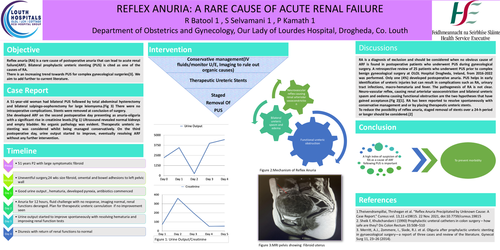
A 51-year-old woman had bilateral PUS followed by total abdominal hysterectomy and bilateral salpingo-oophorectomy for large leiomyoma.(Fig 3) There were no intraoperative complications. Stents were removed at conclusion of surgery.
She developed ARF on the second postoperative day presenting as anuria-oliguria with a significant rise in creatinine levels.(Fig 1) Ultrasound revealed normal kidneys and empty bladder. No organic pathology was evident. Therapeutic ureteric re-stenting was considered whilst being managed conservatively. On the third postoperative day, urine output started to improve, eventually resolving ARF without any further intervention
DISCUSSION
RA is a diagnosis of exclusion and should be considered when no obvious cause of ARF is found in postoperative patients who underwent PUS during gynecological surgery. A retrospective review of 25 patients who underwent PUS prior to complex benign gynecological surgery at OLOL Hospital Drogheda, Ireland, from 2016-2022 was performed. Only one (4%) developed postoperative anuria. PUS helps in early identification of ureteric injuries but can result in complications such as RA, urinary tract infections, macro-hematuria and fever. The pathogenesis of RA is not clear. Neuro-vascular reflex, causing renal arteriolar vasoconstriction and bilateral ureteric spasm and oedema causing functional obstruction are the two hypotheses that have gained acceptance.(Fig 2)[1]. RA has been reported to resolve spontaneously with conservative management and or by placing therapeutic ureteric stents.
To reduce the possibility of reflex anuria, staged removal of stents over a 24-h period or longer should be considered.[2]
CONCLUSION
A high index of suspicion of RA as a cause of ARF following PUS is important to prevent morbidity.
REFERENCES
1.Theivendrampillai, Thrshegan et al. “Reflex Anuria Precipitated by Unknown Cause: A Case Report.” Cureus vol. 13,11 e19815. 22 Nov. 2021, doi:10.7759/cureus.19815
2. Sheik F, Khubchandani I (1990) Prophylactic ureteral catheters in colon surgery – how safe are they? Dis Colon Rectum 33:508–510
3. Merritt, A.J., Zommere, I., Slade, R.J. et al. Oliguria after prophylactic ureteric stenting in gynaecological surgery—a report of three cases and review of the literature. Gynecol Surg 11, 23–26 (2014).