1,830 posters, 67 videos, 75 audios, 29 topics, 22 sessions, 4,727 authors, 1,697 institutions
ePostersLive by SciGen Technologies S.A. All rights reserved.
RCOG World Congress 2023
June 12 - 14, 2023 | London, UK

PP.0211
Synchronous ovarian clear cell carcinoma and Bartholin gland adenoid cystic carcinoma
Poster Presenter
Authors
Affiliations
Part of Topic
Gynae Oncology
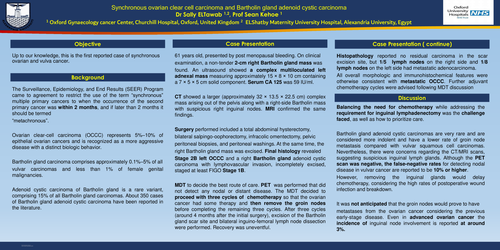
Objectives: Up to our knowledge, this is the first reported case of synchronous ovarian and vulva cancer.
Case report: Post-menopausal lady, with complex adnexal mass and 2 cm Bartholin gland mass. Ca125 was 59 IU/ml. Cytoreductive surgery and wide local excision Bartholin mass were carried out. Histopathology showed stage 2B left ovarian clear cell carcinoma and synchronous right Bartholin gland adenoid cystic carcinoma with lymph vascular invasion, incompletely excised staged at least FIGO stage 1B. Following local MDT discussion and PET scan review, the plan to start 3 cycles of adjuvant chemotherapy then proceed with Bartholin gland scar re-excision and bilateral groin LN dissection. The groin LN showed metastatic adenocarcinoma with overall morphological and immunohistochemical features consistent with metastatic ovarian clear cell carcinoma. The finding of inguinal LN metastases upstages the ovarian carcinoma to FIGO stage IVB. Post operative adjuvant chemotherapy was given. Initial follow up period over 6 months was uneventful.
Discussion: when managing synchronous tumours, the main challenge is to find an anticancer therapy that addresses the active malignancies but does not increase toxicity, or cause interactions, nor have an adverse impact on the overall outcomes. The challenge in our reported case, was which active cancer should we target as a completion therapy: should we start adjuvant chemotherapy for advanced ovarian cancer or should we proceed with completion surgery by re-excision of the vulva scar and bilateral inguinal LN dissection. Putting into account, that the high incidence of wound breakdown following systematic groin dissection, will delay the initiation of adjuvant chemotherapy and the time factor may evoke disease progression. In our reported case, the 2 treatment options were contradicting each other, surgery versus chemotherapy. In the more common synchronous uterine and ovarian cancer, association may be explained by either a mutation or an overexpression of BRCA1/BRCA2, and by MMR genes. In our reported case, no link can be found between ovarian and vulva cancers. In our case study, was the groin lymph nodes involved at the time of first presentation, if yes, why did the still be positive after 3 cycles of chemotherapy. If not, does this reflects disease progression while on chemotherapy - a chemotherapy resistance. Is upstaging the cancer to stage 1VB after 4 months from the initial surgical stage sounds a usual pathological practice?!
Conclusion:
Reporting these rare entities, provide nidus for clinicians to navigate the most appropriate management as there is no available consensus.