1,830 posters, 67 videos, 75 audios, 29 topics, 22 sessions, 4,727 authors, 1,697 institutions
ePostersLive by SciGen Technologies S.A. All rights reserved.
RCOG World Congress 2023
June 12 - 14, 2023 | London, UK

PP.0202
SUCCESSFUL ATTEMPT OF HYDROSTATIC REDUCTION FOLLOWING SUBACUTE UTERINE INVERSION USING FOLEY CATHETER
Poster Presenter
Authors
M.M.H. Dissanayake, C.D. Weerawardhana, L.M. Adikari, S.A. Ruwanpathirana
Affiliations
Part of Topic
Labour Ward Management
SUCCESSFUL ATTEMPT OF HYDROSTATIC REDUCTION FOLLOWING SUBACUTE UTERINE INVERSION USING FOLEY CATHETER
MMH Dissanayake1, CD Weerawardhana1, LM Adikari1, SA Ruwanpathirana1
1De Soyza Hospital for Women, Colombo, Sri Lanka
Objective: Subacute postpartum uterine inversion occurs when the uterine fundus collapses into the endometrial cavity between 24 h to 1 month postpartum. Nowadays it is a rare obstetric emergency because of active 3rd stage management. But it can be potentially fatal when not diagnosed and treated at an early stage.
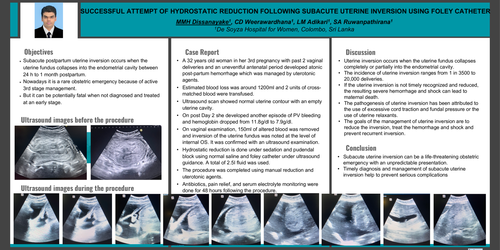
Case report: A 32 years old woman in her 3rd pregnancy with past 2 vaginal deliveries and an uneventful antenatal period developed atonic post-partum hemorrhage which was managed by uterotonic agents. Estimated blood loss was around 1200ml and 2 units of cross-matched blood were transfused. Ultrasound scan showed normal uterine contour with an empty uterine cavity. On post Day 2 she developed another episode of PV bleeding and hemoglobin dropped from 11.8g/dl to 7.9g/dl. On vaginal examination, 150ml of altered blood was removed and inversion of the uterine fundus was noted at the level of internal OS. It was confirmed with an ultrasound examination. Hydrostatic reduction is done under sedation and pudendal block using normal saline and foley catheter under ultrasound guidance. A total of 2.5I fluid was used. The procedure was completed using manual reduction and uterotonic agents. Antibiotics, pain relief, and serum electrolyte monitoring were done for 48 hours following the procedure.
Discussion: Uterine inversion occurs when the uterine fundus collapses completely or partially into the endometrial cavity. The incidence of uterine inversion ranges from 1 in 3500 to 20,000 deliveries. If the uterine inversion is not timely recognized and reduced, the resulting severe hemorrhage and shock can lead to maternal death. The pathogenesis of uterine inversion has been attributed to the use of excessive cord traction and fundal pressure or the use of uterine relaxants. The goals of the management of uterine inversion are to reduce the inversion, treat the hemorrhage and shock and prevent recurrent inversion.
Conclusion: Subacute uterine inversion can be a life-threatening obstetric emergency with an unpredictable presentation. Timely diagnosis and management of subacute uterine inversion help to prevent serious complications.