1,830 posters, 67 videos, 75 audios, 29 topics, 22 sessions, 4,727 authors, 1,697 institutions
ePostersLive by SciGen Technologies S.A. All rights reserved.
RCOG World Congress 2023
June 12 - 14, 2023 | London, UK

PP.0200
Predictive value of circulating AMH in PCOS women receiving clomiphene-citrate: a meta-analysis
Poster Presenter
Part of Topic
Reproductive Medicine/Assisted Reproduction
Circulating AMH predictive value in PCOS women receiving clomiphene citrate: a meta-analysis
Dr Shaimaa Aboeldalyl1, Dr Subul Bazmi1, Mrs Lindsay Snell1, Professor Saad Amer2
1University Hospitals of Derby and Burton NHS Foundation Trust, Derby, United Kingdom. 2University of Nottingham, Derby, United Kingdom
TITLE
Circulating AMH predictive value in PCOS women receiving clomiphene citrate: a meta-analysis
ABSTRACT
Objective: Elevated circulating AMH is a common feature of polycystic ovarian syndrome (PCOS) and is known to lower sensitivity of ovarian follicles to FSH, thereby inhibiting ovulation. This effect may compromise ovarian response to ovulation induction in PCOS women. The aim of this study was to determine if PCOS-related high AMH predicts poor response to clomiphene citrate (CC).
Design: Systematic review and meta-analysis
Methods: An extensive electronic search was conducted from January 2000 to September 2021 to identify available research articles investigating the predictive value of serum AMH levels in PCOS women receiving CC. All cohort, cross-sectional, and randomized studies were considered. Risk of bias and quality of included articles were assessed using modified Newcastle-Ottawa scale. Outcomes included serum AMH levels in responders versus responders (ovulation and pregnancy). Other outcomes included sensitivity, specificity, and area under the receiver operator characteristic curve (AUC) of AMH for predicting response to CC. Data were extracted and entered into RevMan 5.1 for meta-analysis. Standardized mean difference (SMD, 95%CI) in AMH between responders versus non-responders was calculated.
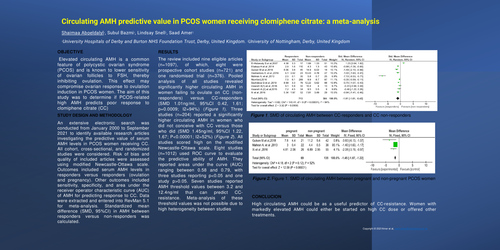
Results: The review included nine eligible articles (n=1097), of which, eight were prospective cohort studies (n=721) and one randomised trial (n=376). Pooled analysis of all studies revealed significantly higher circulating AMH in women failing to ovulate on CC (non-responders) versus CC-responders (SMD 1.01ng/ml, 95%CI 0.42, 1.61; p=0.0009; I2=94%). Three studies (n=204) reported a significantly higher circulating AMH in women who did not conceive with CC versus those who did (SMD 1.45ng/ml, 95%CI 1.22, 1.67; P<0.00001; I2=52%). All studies scored high on the modified Newcastle-Ottawa scale. Eight studies (n=1012) used ROC curve to evaluate the predictive ability of AMH. They reported areas under the curve (AUC) ranging between 0.58 and 0.79, with three studies reporting p<0.05 and one study p>0.05. Seven studies reported AMH threshold values between 3.2 and 12.4ng/ml that can predict CC-resistance. Meta-analysis of these threshold values was not possible due to high heterogeneity between studies
Conclusion: High circulating AMH could be as a useful predictor of CC-resistance. Women with markedly elevated AMH could either be started on high CC dose or offered other treatments.