1,830 posters, 67 videos, 75 audios, 29 topics, 22 sessions, 4,727 authors, 1,697 institutions
ePostersLive by SciGen Technologies S.A. All rights reserved.
RCOG World Congress 2023
June 12 - 14, 2023 | London, UK

EP.0186
Feto-maternal outcomes of pregnancies in women with SLE. An experience from Asia
Poster Presenter
Authors
Dure Shahwar, Amir Raza, Riaz Mehmood, Ayesha Malik, Shehla Ilyas
Affiliations
Part of Topic
High Risk Pregnancy
Feto-maternal outcomes of pregnancies in women with SLE: Experience from a tertiary care center of Asia
Shahwar D, Raza A, Mehmood R, Malik A, Ilyas S
Obstetrics &Gynaecology, Aga Khan University Hospital, Karachi, Pakistan
Background:
Systemic lupus erythematosus (SLE) is an autoimmune disease of reproductive age and predominantly affects the third and fourth decades of life. Most women with SLE experience worsening disease activity during pregnancy and are at high risk of developing a maternal and perinatal complication
Objectives:
We aim to quantify the risk of maternal and fetal complications in patients with SLE in order to identify the impact of SLE on pregnancy and of pregnancy on SLE.
Methodology:
A retrospective case-control record review was conducted in the obstetrics and gynecology unit of AKUH from Jan 1998 to 2018. Outcomes were analyzed in 125 pregnancies(cases) and compared with 396 pregnancies (control group). Both groups were matched for demographic variables.
Results:
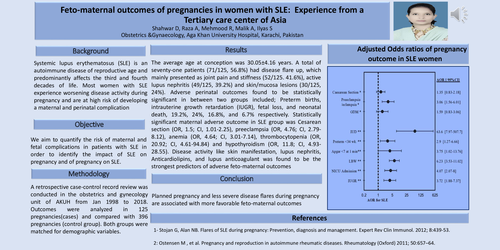
The average age at conception was 30.05±4.16 years. A total of seventy-one patients (71/125, 56.8%) had disease flare up, which mainly presented as joint pain and stiffness (52/125. 41.6%), active lupus nephritis (49/125, 39.2%) and skin/mucosa lesions (30/125, 24%). Adverse perinatal outcomes found to be statistically significant in between two groups included; Preterm births, intrauterine growth retardation (IUGR), fetal loss, and neonatal death, 19.2%, 24%, 16.8%, and 6.7% respectively. A statistically significant maternal adverse outcome in the SLE group was Cesarean section (OR, 1.5; CI, 1.01-2.25), preeclampsia (OR, 4.76; CI, 2.79-8.12), anemia (OR, 4.64; CI, 3.01-7.14), thrombocytopenia (OR, 20.92; CI, 4.61-94.84) and hypothyroidism (OR, 11.8; CI, 4.93-28.55). Disease activity like skin manifestation, lupus nephritis, Anticardiolipins, and lupus anticoagulant was found to be the strongest predictors of adverse feto-maternal outcomes.
Conclusion:
Planned pregnancy and less severe disease flares during pregnancy are associated with more favorable feto-maternal outcomes
References:
1- Stojan G, Alan NB. Flares of SLE during pregnancy: Prevention, diagnosis, and management. Expert Rev ClinImmunol. 2012; 8:439-53.
2: Ostensen M , et al. Pregnancy and reproduction in autoimmune rheumatic diseases. Rheumatology (Oxford) 2011; 50:657–64.