1,830 posters, 67 videos, 75 audios, 29 topics, 22 sessions, 4,727 authors, 1,697 institutions
ePostersLive by SciGen Technologies S.A. All rights reserved.
RCOG World Congress 2023
June 12 - 14, 2023 | London, UK

PP.0197
Treatment Patterns in Abnormal Postpartum Uterine Bleeding or Hemorrhage (2016-2022)
Part of Topic
Maternal Medicine
Treatment Patterns in Abnormal Postpartum Uterine Bleeding or Hemorrhage (2016–2022)
Kara M. Rood1, Candice Yong2, Patricia I. Carney2, Brian Seal2, Seungyoung Hwang2, Roy M. Brooks3
1The Ohio State University-Wexner Medical Center, Columbus, OH;2Organon & Co., Jersey City, NJ; 3Capital Women’s Care, Laurel, MD & Holy Cross Hospital, Silver Spring, MD
Background
- Postpartum hemorrhage (PPH) is the leading cause of maternal morbidity and mortality worldwide accounting for ~25% of the deaths annually1
- Although PPH is largely deemed preventable with timely recognition and treatment, the rate of PPH in the US has increased from 2.7% in the year 2000 to 4.3% in 20192
- Uterotonic (UT) medications are the first-line of treatment to reduce the blood loss during childbirth involving PPH, and uterine balloon tamponade (UBT) is often used in patients who do not respond to UTs3,4,5
- WHO guidelines for use of tranexamic acid (TXA) in PPH management were updated after the 2017 publication of the WOMAN trial6,7
Study Aim, Design, and Outcomes
- This retrospective, observational study aimed to describe rates of abnormal postpartum uterine bleeding/PPH over time and treatment patterns for UTs, TXA, and other interventions among hospital births involving abnormal postpartum uterine bleeding or PPH
- Data for all births in patients ≥15 years old associated with abnormal postpartum uterine bleeding or PPH in the US Premier Hospital Database (Jan 2016–Mar 2022) were included
- Abnormal bleeding or PPH was defined as follows
- Second-line use of UT beyond oxytocin (i.e., carboprost, methylergonovine, misoprostol ≥800 μg), or TXA was a proxy for abnormal postpartum uterine bleeding
- PPH was defined by ≥1 International Classification of Diseases (ICD) 10 code - Descriptive results for diagnosis rates, treatment patterns, and combination therapy over time are presented
Study Population
- A total of 787,964 patients (14.7%) were diagnosed with PPH and/or received second-line UTs
- Patients had a mean age±SD of 29.0±6.0 years and 50.7% were non-Hispanic White; 34.1% underwent a cesarean section
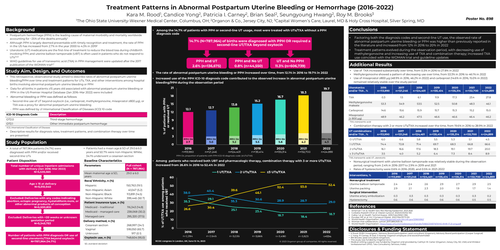
- Among the 14.7% of patients with PPH or second-line UT usage, most were treated with UTs/TXA without a PPH diagnosis code
- The rate of abnormal postpartum uterine bleeding or PPH increased over time, from 12.1% in 2016 to 19.7% in 2022
- Increased use of the PPH ICD-10 diagnosis code contributed to the observed increase in abnormal postpartum uterine bleeding/PPH during the observation period
- Among patients who received both UBT and pharmacologic therapy, combination therapy with 3 or more UTs/TXA increased from 26.6% in 2016 to 52.4% in 2022
Conclusions
- Factoring both the diagnosis codes and second-line UT use, the observed rate of abnormal postpartum uterine bleeding or PPH was higher than previously reported in the literature and increased from 12% in 2016 to 20% in 2022
- Treatment patterns evolved during the observation period, with decreasing use of methylergonovine and increasing use of TXA and combination therapy; increased TXA use coincided with the WOMAN trial and guideline updates
Additional Results
- Use of TXA increased substantially over time, from 0.3% in 2016 to 27.8% in 2022
- Methylergonovine showed a pattern of decreasing use over time, from 53.3% in 2016 to 46.1% in 2022
- Use of misoprostol ≥800 μg (48.9% in 2016, 46.2% in 2022) and carboprost (14.6% in 2016, 15.0% in 2022) remained relatively stable over the study period
- Combination therapy with 2 or more UTs/TXA increased over the time, from 19.6% in 2016 to 28.9% in 2022
- Nonsurgical treatment with uterine balloon tamponade was relatively stable during the observation period, ranging from 2.4% in 2016-2017 to 2.9% in 2019 and 2021
- Rates of hysterectomy were 0.6% in 2016-2020, and 0.5% in 2021-2022