1,830 posters, 67 videos, 75 audios, 29 topics, 22 sessions, 4,727 authors, 1,697 institutions
ePostersLive by SciGen Technologies S.A. All rights reserved.
RCOG World Congress 2023
June 12 - 14, 2023 | London, UK

PP.0196
Uterine artery Doppler indices and adverse perinatal outcomes: a prospective cohort study
Poster Presenter
Part of Topic
Fetal Medicine
Uterine artery Doppler indices and adverse perinatal outcomes: a prospective cohort study
Samuel Dockree, Michael Shea, Carolina Longo, Despoina Kitmiridou, Christos Ioannou, Lawrence Impey
Oxford University Hospitals NHS Foundation Trust, Oxford
Background
Abnormal uterine artery Doppler indices (UAD) predict pre-eclampsia and intrauterine growth restriction, which are associated with perinatal mortality and morbidity. UADs may be measured to inform decisions on growth surveillance, but it is less clear how UADs can be used to identify pregnancies with a high risk of perinatal mortality, severe morbidity and preterm birth.
Methods
Since 2016, women receiving antenatal care at John Radcliffe Hospital, Oxford, have had UADs measured at 18-21 weeks as part of the Oxford Growth Restriction Identification Programme. All women had a universal growth scan at 36 weeks, and women with a mean pulsatility index >1.25 (90th centile) had additional surveillance at 28 and 32 weeks.
For this prospective cohort study, the population was limited to women with singleton pregnancies and morphologically normal babies. Using Cox proportional hazards regression models, women were followed from the mid-trimester scan until birth, to investigate the incidence of perinatal death, severe small-for-gestational age (SGA, <3rd centile) and severe premature iatrogenic birth (<32 weeks) associated with varying degrees of elevation in the uterine artery pulsatility index (PI).
Results
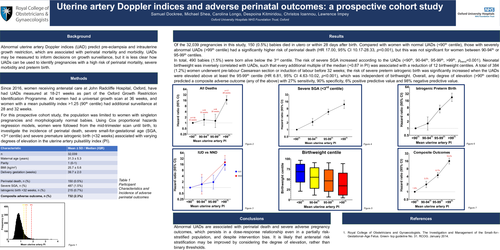
Of the 32,039 pregnancies in this study, 150 (0.5%) babies died in utero or within 28 days after birth. Compared with women with normal UADs (<90th centile), those with severely abnormal UADs (>99th centile) had a significantly higher risk of perinatal death (HR 17.00, 95% CI 10.17-28.33, p<0.001), but this was not significant for women between 90-94th or 95-99th centiles.
In total, 490 babies (1.5%) were born alive below the 3rd centile. The risk of severe SGA increased according to the UADs (<90th, 90-94th, 95-99th, >99th, ptrend<0.001). Neonatal birthweight was inversely correlated with UADs, such that every additional multiple of the median (+0.87 in PI) was associated with a reduction of 12 birthweight centiles. A total of 384 (1.2%) women underwent pre-labour Caesarean section or induction of labour before 32 weeks; the risk of severe preterm iatrogenic birth was significantly increased when the UADs were elevated above at least the 95-99th centile (HR 6.81, 95% CI 4.63-10.02, p<0.001), which was independent of birthweight. Overall, any degree of elevation (>90th centile) predicted a composite adverse outcome (any of the above) with 27% sensitivity, 90% specificity, 6% positive predictive value and 98% negative predictive value.
Conclusions
Abnormal UADs are associated with perinatal death and severe adverse pregnancy outcomes, which persists in a dose-response relationship even in a partially risk- stratified population, and despite intervention bias. It is likely that antenatal risk stratification may be improved by considering the degree of elevation, rather than binary thresholds.