1,830 posters, 67 videos, 75 audios, 29 topics, 22 sessions, 4,727 authors, 1,697 institutions
ePostersLive by SciGen Technologies S.A. All rights reserved.
RCOG World Congress 2023
June 12 - 14, 2023 | London, UK

PP.0192
Diagnostic value of early postnatal compared with standard oral glucose tolerance test.
Poster Presenter
Authors
Affiliations
Part of Topic
Maternal Medicine
Study Title: Diagnostic Value of Early vs Routine Postpartum OGTT for detection of pre-existing Diabetes mellitus in Women diagnosed with GDM. A prospective pilot study
Dr Mark Lui,
Dr Ryan Lee,
Dr Ann Wright
BACKGROUND: Gestational Diabetes (GDM), affects one in every 4-5 pregnancies. In Singapore, there is a universal screening programme for GDM with an oral glucose tolerance test (OGTT) at 24-28 weeks gestation and women with risk factors, particularly a history of GDM are tested in early gestation. After delivery, a post-natal OGTT for those women antenatally diagnosed with GDM is offered at 6-12 weeks to screen for persistent disorders of glucose metabolism. Several small studies have evaluated the effectiveness of the early post-natal glucose tolerance test being performed within 1 to 2 days of delivery during hospitalization with high sensitivity and specificity for the detection of DM. This is the first study of this kind in a South-east Asian population in Singapore.
METHOD: The study was conducted as a prospective cohort pilot study with recruitment of 50 women antenatally diagnosed with GDM using the IADPSG criteria. Participating subjects underwent a 75g 2-hour OGTT on postpartum day 1-3 as well as a routine post-natal 6-week OGTT. Results of the early OGTT were compared to those at 6 weeks to assess the diagnostic value of the early postpartum OGTT for the diagnosis of disorders of glucose metabolism with that of the 6 weeks postpartum OGTT
OBJECTIVE: To evaluate the diagnostic value of an early post-natal OGTT test administered during the delivery hospitalization compared with the routine 6-week OGTT in patients diagnosed antenatally to have GDM. The hypothesis is that an early post-natal OGTT is equally effective and non-inferior when compared with the routine 6-week OGTT in patients antenatally screened to have GDM.
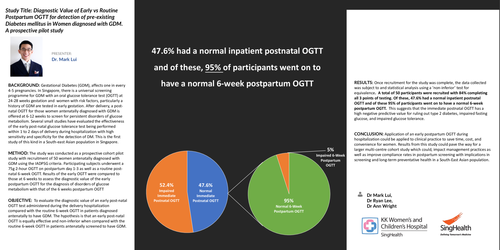
RESULTS: Once recruitment for the study was complete, the data collected was subject to and statistical analysis using a ‘non-inferior’ test for equivalence. A total of 50 participants were recruited with 84% completing all 3 points of testing. Of these, 47.6% had a normal inpatient postnatal OGTT and of these 95% of participants went on to have a normal 6-week postpartum OGTT. This suggests that the immediate postnatal OGTT has a high negative predictive value for ruling out type 2 diabetes, impaired fasting glucose, and impaired glucose tolerance.
CONCLUSION: Application of an early postpartum OGTT during hospitalization could be applied to clinical practice to save time, cost, and convenience for women. Results from this study could pave the way for a larger multi-centre cohort study which could, impact management practices as well as improve compliance rates in postpartum screening with implications in screening and long-term preventative health in a South-East Asian population.