1,830 posters, 67 videos, 75 audios, 29 topics, 22 sessions, 4,727 authors, 1,697 institutions
ePostersLive by SciGen Technologies S.A. All rights reserved.
RCOG World Congress 2023
June 12 - 14, 2023 | London, UK

PP.0180
Adolescent Turner Syndrome – Service Evaluation at UK Tertiary Teaching Hospital Clinic
Poster Presenter
Part of Topic
Adolescent Gynaecology
Adolescent Turner Syndrome - Service Exualtion at a UK Tertiary Teaching Hospital Clinic
Objective: Turner Syndrome (TS) is a genetic disorder affecting only females which is associated with a range of symptoms and characteristics including affected sexual development and subfertility. 70-80% of TS women don’t undergo spontaneous puberty and so pubertal induction plays a key role. Only 2-5% can conceive naturally. Fertility treatment is an option for some TS women, but they must be identified and counselled early to maximize its benefits.
Our aim was to assess whether we are meeting the standards of best practice for management based on the 2016 Cincinnati Guidelines for adolescent TS patients. We focused on:
- Appropriate pubertal induction
- Fertility preservation and counselling
- Continuity of care during transition from paediatric to adult TS clinic
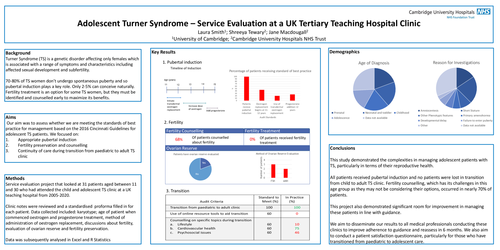
Design: Service evaluation project that looked at 31 patients aged between 11 and 30 who had attended the child and adolescent TS clinic at a UK teaching hospital between 2005 and 2020.
Methods: Clinic notes were reviewed and a standardised proforma filled in for each patient. Data collected included: karyotype; age of patient when commenced oestrogen and progesterone treatment, method of administration of oestrogen replacement, discussions about fertility, evaluation of ovarian reserve and fertility preservation.
Data was subsequently analysed in Excel and R Statistics
Results: Our results showed good clinical care with regards to pubertal induction being offered to 100% of TS patients. Improvement could be made in timings and method of administration of hormone replacement regimes. 80% received oestrogen orally rather than the preferred transdermal method of administration and only 26% received add-on progesterone therapy at the optimal time.
70% of patients received documented consultations about fertility and 19% had their ovarian reserve evaluated.
There was very good continuity of care with 100% patients sampled transitioning to the adult TS clinic. Transition could be aided by using online support tools.
Conclusions This study demonstrated the complexities in managing adolescent patient with TS, particularly in terms of their reproductive health.
We highlighted many good practices within this tertiary clinic. All patients received pubertal induction and no patients were lost in transition from child to adult TS clinic. Fertility counselling, which has its challenges in this age group as they may not be considering their options, occurred in nearly 70% of patients.
This project also demonstrated significant room for improvement in managing these patients in line with guidance.
We aim to disseminate our results to all medical professionals conducting these clinics to improve adherence to guidance and reassess in 6 months. We also aim to conduct a patient satisfaction questionnaire, particularly for those who have transitioned from paediatric to adolescent care.