1,830 posters, 67 videos, 75 audios, 29 topics, 22 sessions, 4,727 authors, 1,697 institutions
ePostersLive by SciGen Technologies S.A. All rights reserved.
RCOG World Congress 2023
June 12 - 14, 2023 | London, UK

PP.0179
Causes of amenorrhea referred to a tertiary clinic: a case series 2022
Poster Presenter
Part of Topic
Adolescent Gynaecology
Video
Causes of amenorrhea referred to tertiary clinic: a case series 2022
Vandermolen B; Clarke, S; Yasmin, E; Davies, M; Brain, C; Learner, HI
Background:
Primary and secondary amenorrhea is a common indication for referral to adolescent gynaecology.
Amenorrhoea has several causes including structural abnormalities and endocrine dysfunction.
Diagnosis can be challenging but essential to ensure provision of optimal treatment options and advice on any long-term implications of their condition.
Objective:
This study aimed to describe the distribution of causes of amenorrhea referred to a tertiary centre in the UK.
Methods:
A retrospective review of patients seen in a tertiary adolescent gynecology service referred with amenorrhea or for transition of their Differences of Sex Development(DSD) care.
Data on age, clinical findings, and management was extracted from medical records of new patients seen in 2022.
The data was collected and analysed on Excel.
Results:
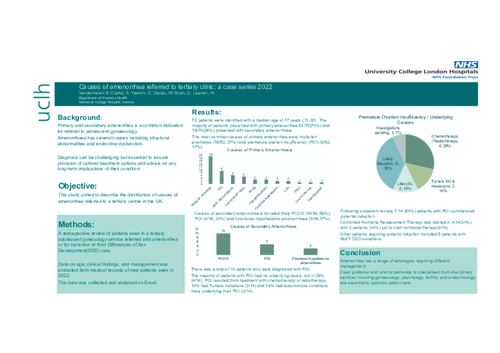
70 patients were identified with a median age of 17 years (11-30). The majority of patients presented with primary amenorrhea 52/70(74%) and 18/70(26%) presented with secondary amenorrhoea.
The most common causes of primary amenorrhea were mullerian anomalies (19/52, 37%) and premature ovarian insufficiency (POI) (9/52, 17%).
Causes of secondary amenorrhoea included likely PCOS (10/18, 56%), POI (4/18, 22%) and functional hypothalamic amenorrhoea (3/18,17%).
There was a total of 14 patients who were diagnosed with POI.
The majority of patients with POI had no underlying cause, but in 29% (4/14), POI resulted from treatment with chemotherapy or radiotherapy. 14% had Turners variations (2/14) and 14% had autoimmune conditions likely underlying their POI (2/14).
Following outpatient review, 7/14 (54%) patients with POI commenced pubertal induction.
Combined Hormone Replacement Therapy was started in 4/14(31%) with 2 patients (14%) yet to start hormonal therapy(2/14).
Other patients requiring puberty induction included 5 patients with 46XY DSD conditions.
Conclusion
Amenorrhea has a range of aetiologies requiring different management.
Clear guidance and referral pathways to specialised multi-disciplinary services involving gynaecology, psychology, fertility, and endocrinology are essential to optimise patient care.