1,830 posters, 67 videos, 75 audios, 29 topics, 22 sessions, 4,727 authors, 1,697 institutions
ePostersLive by SciGen Technologies S.A. All rights reserved.
RCOG World Congress 2023
June 12 - 14, 2023 | London, UK

PP.0175
An Evidence Synthesis of Complex Interventions used in Chronic Pain Management (WP1b)
Poster Presenter
Part of Topic
Hot Topics (Emerging research/issues) in Gynaecology
Chronicpainimpactsapproximately1.5billionpeopleglobally. Country or region specific economic, social. health and political contextual factors are closely linked to chronic pain management, impacting quality of life, daily functioning, and mental health. Challenges with managing chronic pain leads to poor clinical and patient reported outcomes, such as disability, anxiety, depression, sleeping disorders, addiction, diminished quality of life, respectively(1).
With a growing and aging population, the global burden of chronic pain continues to rise. To address this, developing clinically and cost effective, evidence-based and minimally invasive interventions would be highly beneficial. Inlinewiththis,researchershaveinitiatedavarietyof exploratory studies to asses the efficacy of combined therapeutic strategies.
These complex interventions, target physiological and psychological pain indicators with a view to reduce pain and improve the psychosocial functioning of patients. Common complex interventions include exercise, yoga, pilates and acupuncture-related treatments indicating some promise to manage chronic pain (1, 2).
This study was designed to assess the current evidence landscape to better understand and report the efficacy and potential effectiveness of complex interventions.
METHODS
A systematic methodology was designed and published in PROSPERO (CRD42021235384). Multiple databases were used to extract data from randomised clinical trials, epidemiology and mixed methods studies that were peer reviewed and published in English between the 1st of January 1990 and 31st of April 2022. We used a pairwise meta-analysis to report a single estimate of pooled effects from selected interventions and then used the most commonly reported exercise related interventions to develop two subnets to report a network meta-analysis.
Outcomes/Outcome measures:
Painintensitymeasuredbyvisualanaloguescale(VAS)
Paindisabilitymeasurebyimpactonpsychologicalandphysicalhealth
RESULTS
Of the 168 systematically included studies 46 were meta- analysed.
Comparisons of pain intensity under exercise-related interventions
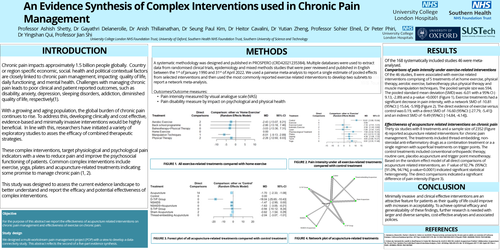
Of the 46 studies, 8 were associated with exercise related interventions comprising of 5 treatments of at home exercise, physical therapy, aerobic exercise, balneotherapy plus physical therapy and muscle manipulation techniques. The pooled sample size was 594. The pooled standard mean deviation (SMD) was -6.01 with a 95% CI (- 9.13, -2.89) and a p-value <0.0001 (Figure 1). Exercise treatments had a significant decrease in pain intensity, with a network SMD of -10.81 (95%CI: [-15.64, -5.99]) (Figure 2). The direct evidence of exercise versus control was 0.19, with a direct SMD of -16.60 (95%CI: [-27.79, -5.41]) and an indirect SMD of -9.49 (95%CI: [-14.84, -4.14]).
Effectiveness of acupuncture related interventions on chronic pain
Thirty six studies with 8 treatments and a sample size of 2352 (Figure 4) reported acupuncture related interventions for chronic pain management. The treatments included thread-embedding, non- steroidal anti-inflammatory drugs as a combination treatment or a a single regimen with superficial treatments on trigger points. The control treatments included conventional orthopaedic therapy, routine care, placebo acupuncture and trigger point mesotherapy. Based on the random effect model of all direct comparisons of acupuncture related interventions, an I2 value of 92.7% (95%CI: [91.0%, 94.1%], p-value<0.0001) indicated significant statistical heterogeneity. The direct comparisons indicated a significant difference of pain intensity (Figure 3).
CONCLUSION
Minimallyinvasive andclinicaleffectiveinterventionsarean attractive feature for patients as their quality of life could improve with increases in acceptability. To achieve optimal efficacy and generalizability of these findings, further research is needed with larger and diverse samples, cost-effective analyses and associated policies.
FIGURE 2. Pain intensity under all exercise-related treatments compared with control treatment
Objective
For the purpose of this abstract we report the effectiveness of acupuncture related interventions on chronic pain management and effectiveness of exercise on chronic pain.
Study design
We designed a multi-workstream pain management project (POP) with a view to develop a data- connectivity study. This abstract reflects the second of a five-part evidence synthesis.
REFERENCES
1. Geneen LJ, Moore RA, Clarke C, Martin D, Colvin LA, Smith BH. Physical activity and exercise for chronic pain in adults: an overview of Cochrane Reviews. Cochrane Database Syst Rev. 2017 Apr 24;4(4):CD011279. doi: 10.1002/14651858.CD011279.pub3. PMID: 28436583; PMCID: PMC5461882.
2. Vickers AJ, Vertosick EA, Lewith G, MacPherson H, Foster NE, Sherman KJ, Irnich D, Witt CM, Linde K; Acupuncture Trialists' Collaboration. Acupuncture for Chronic Pain: Update of an Individual Patient Data Meta-Analysis. J Pain. 2018 May;19(5):455-474. doi: 10.1016/j.jpain.2017.11.005. Epub 2017 Dec 2. PMID: 29198932; PMCID: PMC5927830