1,830 posters, 67 videos, 75 audios, 29 topics, 22 sessions, 4,727 authors, 1,697 institutions
ePostersLive by SciGen Technologies S.A. All rights reserved.
RCOG World Congress 2023
June 12 - 14, 2023 | London, UK

EP.1676
Restoration of the ovarian function after third ovarian transplantation: a case report
Poster Presenter
Authors
Angela Vidal, Fabienne Lauber, Christine Brambs, Alexandra Kohl Schwartz
Affiliations
Part of Topic
Reproductive Medicine/Assisted Reproduction
Introduction
Premature ovarian insufficiency is one of the most common long-term adverse effects after treatment of malignant diseases with chemotherapy or radiotherapy. There are several options for fertility preservation. Ovarian tissue cryopreservation (OTC) can be initiated without delaying gonadotoxic therapy, as hormonal stimulation is not necessary. Ovarian tissue cryopreservation and subsequent autologous transplantation of thawed tissue is considered the most promising alternative strategy to restore fertility in oncology patients with an average pregnancy rate of 25%.
Case
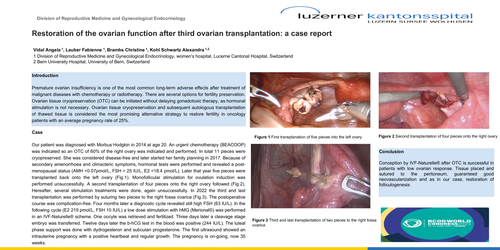
Our patient was diagnosed with Morbus Hodgkin in 2014 at age 20. An urgent chemotherapy (BEACOOP) was indicated so an OTC of 60% of the right ovary was indicated and performed. In total 11 pieces were cryopreserved. She was considered disease-free and later started her family planning in 2017. Because of secondary amenorrhoea and climacteric symptoms, hormonal tests were performed and revealed a post-menopausal status (AMH <0.07pmol/L, FSH > 25 IU/L, E2 <18.4 pmol/L). Later that year five pieces were transplanted back onto the left ovary (Fig.1). Monofollicular stimulation for ovulation induction was performed unsuccessfully. A second transplantation of four pieces onto the right ovary followed (Fig.2). Hereafter, several stimulation treatments were done, again unsuccessfully. In 2022 the third and last transplantation was performed by suturing two pieces to the right fossa ovarica (Fig.3). The postoperative course was complication-free. Four months later a diagnostic cycle revealed still high FSH (63 IU/L). In the following cycle (E2 219 pmol/L, FSH 10 IU/L) a low dose stimulation with hMG (Merional©) was performed in an IVF-Naturelle® scheme. One oocyte was retrieved and fertilized. Three days later a cleavage stage embryo was transferred. Twelve days later the b-hCG test in the blood was positive (244 IU/L). The luteal phase support was done with dydrogesteron and subcutan progesterone. The first ultrasound showed an intrauterine pregnancy with a positive heartbeat and regular growth. The pregnancy is on-going, now 35 weeks.
Conclusion
Conception by IVF-Naturelle® after OTC is successful in patients with low ovarian response. Tissue placed and sutured to the peritoneum, guaranteed good neovascularization and as in our case, restoration of folliculogenesis.