1,830 posters, 67 videos, 75 audios, 29 topics, 22 sessions, 4,727 authors, 1,697 institutions
ePostersLive by SciGen Technologies S.A. All rights reserved.
RCOG World Congress 2023
June 12 - 14, 2023 | London, UK

PP.0161
Quantitative fetal fibronectin testing in symptomatic women for spontaneous preterm birth prediction
Poster Presenter
Authors
Vivian Wai Yan Ng, Mimi Tin Yan Seto, Holly Lewis, Ka Wang Cheung
Affiliations
Part of Topic
Hot Topics (Emerging research/issues) in Obstetrics
Quantitative fetal fibronectin testing in symptomatic women for spontaneous preterm birth prediction
Vivian Wai Yan Ng, Mimi Tin Yan Seto, Holly Lewis, Ka Wang Cheung
Department of Obstetrics and Gynaecology, Queen Mary Hospital, The University of Hong Kong
Background
Spontaneous preterm birth (PTB) affects 6.5% of deliveries in Hong Kong.
Quantitative fetal fibronectin (fFN) is currently under-utilized as a test for PTB prediction in Hong Kong.
Objectives
To evaluate the effectiveness of quantitative fFN in predicting spontaneous PTB in women with symptoms of threatened preterm labour in our population.
• Primary outcome : test characteristics of quantitative fFN in predicting spontaneous PTB <37 weeks.
• Secondary outcome : investigate relationship between fFN value and time to PTB
Design
A prospective, double blinded cohort study
Methods
• Women with a singleton gestation and preterm labour symptoms presenting to a tertiary hospital in Hong Kong between 24+0 to 33+6 weeks were recruited from 1st October 2020 and 31st October 2021.
• Women with vaginal bleeding, ruptured membranes and cervical dilation
>3 cm were excluded.
• The attending obstetrician and the women were blinded to the result of fFN test; enabling unbiased management of the women.
Results
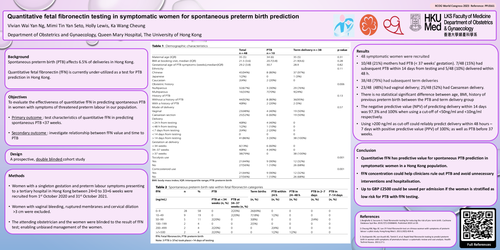
• 48 symptomatic women were recruited
• 10/48 (21%) mothers had PTB (< 37 weeks’ gestation). 7/48 (15%) had subsequent PTB within 14 days from testing and 5/48 (10%) delivered within 48 h.
• 38/48 (79%) had subsequent term deliveries
• 23/48 (48%) had vaginal delivery; 25/48 (52%) had Caesarean delivery.
• There is no statistical significant difference between age, BMI, history of previous preterm birth between the PTB and term delivery group
• The negative predictive value (NPV) of predicting delivery within 14 days was 97.3% and 100% when using a cut-off of <50ng/ml and <10ng/ml respectively.
• Using >200 ng/ml as cut-off could reliably predict delivery within 48 hours – 7 days with positive predictive value (PPV) of 100%; as well as PTB before 37 weeks.
Conclusion
• Quantitative fFN has predictive value for spontaneous PTB prediction in symptomatic women in a Hong Kong population.
• fFN concentration could help clinicians rule out PTB and avoid unnecessary interventions and hospitalisation.
• Up to GBP £2500 could be saved per admission if the woman is stratified as low risk for PTB with fFN testing.
References:
- Berghella V, Saccone G. Fetal fibronectin testing for reducing the risk of pre- term birth. Cochrane Database Syst Rev. 2019;7(7):CD006843. Published 2019 Jul 29.
- Cheung KW, Ngu SF, Lee CP. Fetal fibronectin test on chinese women with symptoms of preterm labour: a pilot study. Hong Kong Med J. 2013;19(5):424–8.
- Deshpande SN, van Asselt AD, Tomini F, et al. Rapid fetal fibronectin testing to predict preterm birth in women with symptoms of premature labour: a systematic review and cost analysis. Health Technol Assess. 2013;17:1.