1,830 posters, 67 videos, 75 audios, 29 topics, 22 sessions, 4,727 authors, 1,697 institutions
ePostersLive by SciGen Technologies S.A. All rights reserved.
RCOG World Congress 2023
June 12 - 14, 2023 | London, UK

PP.0160
Identifying Intrapartum Fetal Early Warning Signs (FEWS) and why we need it?
Poster Presenter
Authors
Affiliations
Part of Topic
Hot Topics (Emerging research/issues) in Obstetrics
OBJECTIVE
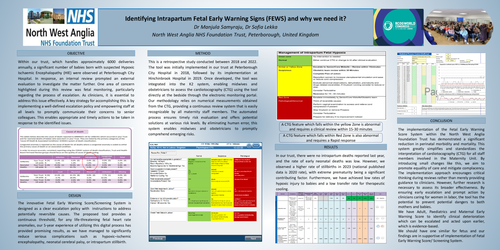
Within our trust, which handles approximately 6000 deliveries annually, a significant number of babies born with suspected Hypoxic Ischaemic Encephalopathy (HIE) were observed at Peterborough City Hospital. In response, an internal review prompted an external evaluation to investigate the matter further. One area of concern highlighted during this review was fetal monitoring, particularly regarding the process of escalation. As clinicians, it is essential to address this issue effectively. A key strategy for accomplishing this is by implementing a well-defined escalation policy and empowering staff at all levels to promptly communicate their concerns to senior colleagues. This enables appropriate and timely actions to be taken in response to the identified issues.
DESIGN
The innovative Fetal Early Warning Score/Screening System is designed as a clear escalation policy with instructions to address potentially reversible causes. The proposed tool provides a continuous threshold, for any life-threatening fetal heart rate anomalies, our 5-year experience of utilizing this digital process has provided promising results, as we have managed to significantly reduce serious complications such as hypoxic–ischemic encephalopathy, neonatal cerebral palsy, or intrapartum stillbirth.
METHOD
This is a retrospective study conducted between 2018 and 2022. The tool was initially implemented in our trust at Peterborough City Hospital in 2018, followed by its implementation at Hinchinbrook Hospital in 2019. Once developed, the tool was integrated into the K2 system, enabling midwives and obstetricians to assess the cardiotocography (CTG) using the tool directly at the bedside through the electronic monitoring portal. Our methodology relies on numerical measurements obtained from the CTG, providing a continuous review system that is easily recognizable by all maternity staff members. The automated process ensures timely risk evaluation and offers potential solutions at various risk levels. By eliminating human error, this system enables midwives and obstetricians to promptly comprehend emerging risks.
RESULTS
In our trust, there were no intrapartum deaths reported last year, and the rate of early neonatal deaths was low. However, we observed a higher rate of stillbirths in 2023 (national published data is 2020 rate), with extreme prematurity being a significant contributing factor. Furthermore, we have achieved low rates of hypoxic injury to babies and a low transfer rate for therapeutic cooling.
CONCLUSION
The implementation of the Fetal Early Warning Score System within the North West Anglia Foundation Trust has demonstrated a significant reduction in perinatal morbidity and mortality. This system greatly simplifies and standardizes the interpretation of cardiotocography (CTG) for all staff members involved in the Maternity Unit. By introducing small changes like this, we aim to promote equality of care and mitigate complacency. The implementation approach encourages critical thinking during reviews rather than merely providing guidance to clinicians. However, further research is necessary to assess its broader effectiveness. By ensuring early escalation and prompt action by clinicians caring for women in labor, the tool has the potential to prevent potential dangers to both mothers and babies.We have Adult, Paediatrics and Maternal Early Warning Score to identify clinical deterioration which can be escalated and acted upon earlier, which is evidence-based.We should have one similar for fetus and our findings are in supportive of implementation of Fetal Early Warning Score/ Screening System.