1,830 posters, 67 videos, 75 audios, 29 topics, 22 sessions, 4,727 authors, 1,697 institutions
ePostersLive by SciGen Technologies S.A. All rights reserved.
RCOG World Congress 2023
June 12 - 14, 2023 | London, UK

EP.0182
Ovulation Induction Response in Non-Obese Versus Obese Women with Polycystic Ovarian Syndrome
Poster Presenter
Authors
Shazia Syed, Unsa Malik, Nighat Naheed, Ismat Batool, Hina Gul
Affiliations
Part of Topic
Obesity
Ovulation Induction Response in Non-Obese Versus Obese Women with Polycystic Ovarian Syndrome
Authors; Shazia Syed, Unsa Malik, NighatNaheed, IsmatBatool, HinaGul
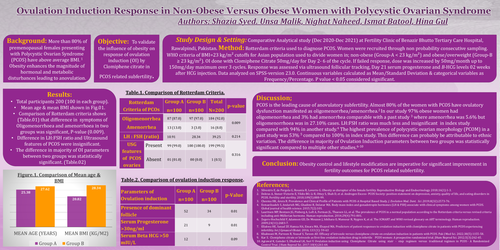
Background: More than 80% of premenopausal females presenting with Polycystic Ovarian Syndrome (PCOS) have above average BMI. 1 Obesity enhances the magnitude of hormonal and metabolic disturbances leading to anovulation.
Objective: To validate the influence of obesity on response of ovulation induction (OI) by Clomiphene citrate in PCOS related subfertility
Study Design & Setting: Comparative Analytical study (Dec 2020-Dec 2021) at Fertility Clinic of Benazir Bhutto Tertiary Care Hospital, Rawalpindi, Pakistan. Method: Rotterdam criteria used to diagnose PCOS. Women were recruited through non probability consecutive sampling. WHO criteria of BMI=23 kg/m² cutoffs for Asian population used to divide women in; non-obese (Group-A < 23 kg/m²) and obese/overweight (Group-B ≥ 23 kg/m²). OI done with Clomiphene Citrate 50mg/day for Day 2- 6 of the cycle. If failed response, dose was increased by 50mg/month up to 150mg/day maximum over 3 cycles. Response was assessed via ultrasound follicular tracking, Day 21 serum progesterone and B-HCG levels 02 weeks after HCG injection. Data analyzed on SPSS-version 23.0. Continuous variables calculated as Mean/Standard Deviation & categorical variables as Frequency/Percentage. P value < 0.05 considered significant.
Results:
Discussion;
PCOS is the leading cause of anovulatory subfertility. Almost 80% of the women with PCOS have ovulatory dysfunction manifested as oligomenorrhea/amenorrhea.2 In our study 97% obese women had oligomenorrhea and 3% had amenorrhea comparable with a past study 3 where amenorrhea was 5.6% but oligomenorrhoea was in 27.10% cases. LH:FSH ratio was much less and insignificant in index study compared with 94% in another study.4 The highest prevalence of polycystic ovarian morphology (PCOM) in a past study was 53% 5 compared to 100% in index study. This difference can probably be attributable to ethnic variation. The difference in majority of Ovulation Induction parameters between two groups was statistically significant compared to multiple other studies.6-10
Conclusion: Obesity control and lifestyle modification are imperative for significant improvement in fertility outcomes for PCOS related subfertility.
References;