1,830 posters, 67 videos, 75 audios, 29 topics, 22 sessions, 4,727 authors, 1,697 institutions
ePostersLive by SciGen Technologies S.A. All rights reserved.
RCOG World Congress 2023
June 12 - 14, 2023 | London, UK

PP.0145
Improved outcomes in integrated perinatal care for substance use disorder
Poster Presenter
Authors
Else Segers, Langeza Saleh, Esther Knijff, Sinno Simons, Johannes Duvekot, Eric Steegers, Hilmar Bijma
Affiliations
Department of Obstetrics and Gynaecology, Division Obstetrics and Fetal Medicine, Erasmus University Medical Center, Department of Psychiatry, Erasmus University Medical Center, Department of Pediatrics, Division Neonatology, Research Neonatology, Erasmus University Medical Center
Part of Topic
High Risk Pregnancy
Video
IMPROVED OUTCOMES IN INTEGRATED PERINATAL CARE FOR SUBSTANCE USE DISORDERS
E.F. Segers1, L. Saleh1, E. Knijff2, S.H.P. Simons3, J.J. Duvekot1, E.A.P. Steegers1, H.H. Bijma1
1Department of Obstetrics and Gynaecology, Division Obstetrics and Fetal Medicine, Erasmus University Medical Center, Rotterdam, The Netherlands. 2Department of Psychiatry, Erasmus University Medical Center, Rotterdam, The Netherlands. 3Department of Pediatrics, Division Neonatology, Research Neonatology, Erasmus University Medical Center, Rotterdam, The Netherlands.
Background: Illicit substance and alcohol use disorders (SUD) in pregnant women are a growing public health problem worldwide and have serious effects on the course of pregnancy and the developing child. Access to integrated care may improve outcomes. We evaluated outcomes before and after the implementation of integrated care services, integrating addiction medicine treatment, social services, child protection services, as well as obstetric, paediatric, and psychiatric care.
Objective: Compare substance use and pregnancy outcomes in women with SUD receiving integrated versus standard care.
Method:
► Retrospective cohort study
► Illicit substance and alcohol use disorders (SUD)
► Standard care versus integrated care
Results:
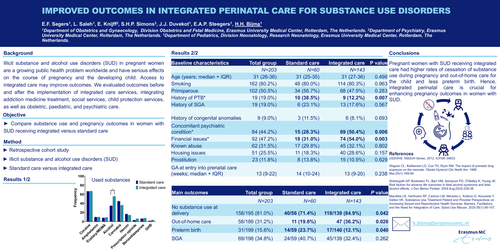
No substance use at delivery: Total group 158/195 (81.0%), Standard care 40/56 (71.4%), Integrated care 118/139 (84.9%); p=0.042.
Out-of-home care: Total group 58/186 (31.2%), Standard care 11 (19.6%), Integrated care 47 (36.2%); p=0.026.
Preterm birth: Total group 31/199 (15.6%), Standard care 14/59 (23.7%), Integrated care 17/140 (12.1%); p=0.040.
SGA: Total group 69/198 (34.8%), Standard care 24/59 (40.7%), Integrated care 45/139 (32.4%); p=0.262.
Conclusions: Pregnant women with SUD receiving integrated care had higher rates of cessation of substance use during pregnancy and out-of-home care for the child and less preterm birth. Hence, integrated perinatal care is crucial for enhancing pregnancy outcomes in women with SUD.