1,830 posters, 67 videos, 75 audios, 29 topics, 22 sessions, 4,727 authors, 1,697 institutions
ePostersLive by SciGen Technologies S.A. All rights reserved.
RCOG World Congress 2023
June 12 - 14, 2023 | London, UK

EP.0180
Management of Obstetric Cardiac Patients at BHRT, North-East London Maternal Medicine Network
Poster Presenter
Part of Topic
Maternal Medicine
Introduction
Cardiac disease remains the largest single cause of indirect maternal deaths in the UK1. With the recent establishment of maternal medicine networks, management of pregnant women with cardiac disease can be undertaken locally with input from the maternal medicine centre (MMC). This study was undertaken to see how many women required escalation and delivery at the MMC.
Methods
A retrospective observational cohort study was undertaken on women who were referred to and seen in the joint obstetric cardiac antenatal clinic at Queen’s Hospital, Barking, Havering and Redbridge Trust in the year 2021.
Results
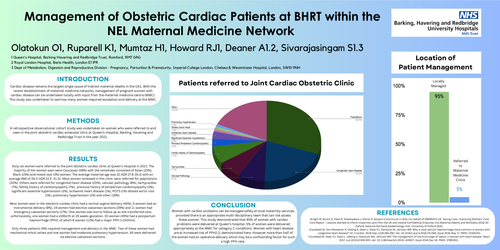
Sixty-six women were referred to the joint obstetric cardiac clinic at Queen’s Hospital in 2021. The majority of the women seen were Caucasian (59%) with the remainder consisted of Asian (23%), Black (15%) and mixed race (3%) women. The average maternal age was 32 (IQR 27.8-35.3) with an average BMI of 26.0 (IQR 22.5 -31.0). Most women reviewed in this clinic were referred for palpitations (30%). Others were referred for congenital heart disease (20%), valvular pathology (8%), tachycardias (7%), family history of cardiomyopathy (7%), previous history of peripartum cardiomyopathy (3%), significant essential hypertension (3%), ischaemic heart disease (1%), POTS (1%) dilated aortic root (1%), pulmonary hypertension (1%) and other (18%).
Most women seen in the obstetric cardiac clinic had a normal vaginal delivery (44%), 5 women had an instrumental delivery (8%), 19 women had elective caesarean sections (29%) and 11 women had emergency caesarean sections (17%). One woman was lost to follow up as she transferred care; unfortunately, one woman had a stillbirth at 35 weeks gestation. 30 women (45%) had a postpartum haemorrhage (PPH); of which 8 women (12%) had a major PPH (>1000ml).
Only three patients (5%) required management and delivery in the MMC. Two of these women had mechanical mitral valves and one woman had moderate pulmonary hypertension. All were delivered via elective caesarean sections.
Conclusion
Women with cardiac problems can be managed safely at local maternity services, provided there is an appropriate multi-disciplinary team that can risk assess these women. This study demonstrated that 95% of women with cardiac problems were delivered at Queen’s hospital. 5% of women were delivered appropriately at the MMC for category C conditions. Women with heart disease are at increased risk of PPH2,3, demonstrated here. However more than half of the women had an operative delivery which may be a confounding factor for such a high PPH rate.
References