1,830 posters, 67 videos, 75 audios, 29 topics, 22 sessions, 4,727 authors, 1,697 institutions
ePostersLive by SciGen Technologies S.A. All rights reserved.
RCOG World Congress 2023
June 12 - 14, 2023 | London, UK

PP.0131
Cervical cerclage for prevention of preterm birth in twin pregnancies
Poster Presenter
Authors
Nashwa Eltaweel, Francesco D’Antonio, Smriti Prasad, Asma Khalil
Affiliations
Fetal Medicine Unit, St George’s University Hospital, Center for Fetal Care and High-Risk Pregnancy, University of Chieti, Division of biomedical science, Warwick medical school university of Warwick, University hospital of Coventry and Warwickshire
Part of Topic
Fetal Medicine
Cervical cerclage for prevention of preterm birth and adverse perinatal outcome in twin pregnancies: Systematic Review and Meta-analysis
Francesco D’Antonio1, Nashwa Eltaweel2, Smriti Prasad3, Asma Khalil3,4,5,6
1Center for Fetal Care and High-Risk Pregnancy, University of Chieti, Chieti, Italy
2Division of biomedical science, Warwick medical school university of Warwick, University hospital of Coventry and Warwickshire
3Fetal Medicine Unit, St George’s University Hospital, London, UK
4Vascular Biology Research Centre, Molecular and Clinical Sciences Research Institute, St George's University of London, London, UK
5Twins Trust Centre for Research and Clinical Excellence, St George’s University Hospital, St George's University of London, London, UK
6Fetal Medicine Unit, Liverpool Women’s Hospital, University of Liverpool, Liverpool, UK
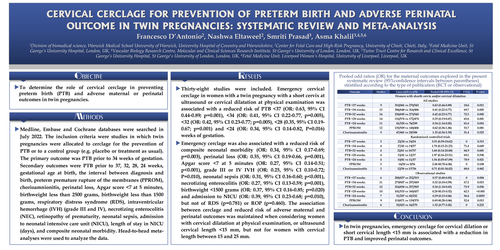
Objective: To determine the role of cervical cerclage in preventing preterm birth (PTB) and adverse maternal or perinatal outcomes in twin pregnancies.
Methods: Medline, Embase and Cochrane databases were searched in July 2022. The inclusion criteria were studies in which twin pregnancies were allocated to cerclage for the prevention of PTB or to a control group (e.g. placebo or treatment as usual). The primary outcome was PTB prior to 34 weeks of gestation. Secondary outcomes were PTB prior to 37, 32, 28, 24 weeks, gestational age at birth, the interval between diagnosis and birth, preterm premature rupture of the membranes (PPROM), chorioamnionitis, perinatal loss, Apgar score <7 at 5 minutes, birthweight less than 2500 grams, birthweight less than 1500 grams, respiratory distress syndrome (RDS), intraventricular hemorrhage (IVH) (grade III and IV), necrotizing enterocolitis (NEC), retinopathy of prematurity, neonatal sepsis, admission to neonatal intensive care unit (NICU), length of stay in NICU (days), and composite neonatal morbidity. Head-to-head meta-analyses were used to analyze the data.
Results: Thirty-eight studies were included. Emergency cervical cerclage in women with a twin pregnancy with a short cervix at ultrasound or cervical dilatation at physical examination was associated with a reduced risk of PTB <37 (OR: 0.63, 95% CI 0.44-0.89; p=0.001), <34 (OR: 0.41, 95% CI 0.22-0.77, p=0.005), <32 (OR: 0.42, 95% CI 0.23-0.77; p=0.005), <28 (0.35, 95% CI 0.19-0.67; p=0.001) and <24 (OR: 0.34, 95% CI 0.14-0.82, P=0.016) weeks of gestation.
Emergency cerclage was also associated with a reduced risk of composite neonatal morbidity (OR: 0.34, 95% CI 0.17-0.69; p=0.003), perinatal loss (OR: 0.35, 95% CI 0.19-0.66, p=0.001), Apgar score <7 at 5 minutes (OR: 0.27, 95% CI 0.14-0.51; p<0.001), grade III or IV IVH (OR: 0.25, 95% CI 0.10-0.72; P=0.010), neonatal sepsis (OR: 0.31, 95% CI 0.16-0.60; p<0.001), necrotizing enterocolitis (OR: 0.27, 95% CI 0.13-0.59; p=0.001), birthweight <1500 grams (OR: 0.37, 95% CI 0.16-0.85; p=0.020) and admission to NICU (OR: 0.39, 95% CI 0.23-0.68; p=0.010), but not of RDS (p=0.781) or ROP (p=0.460). The association between cerclage and reduced risk of adverse maternal and perinatal outcomes was maintained when considering women with cervical dilatation at physical examination, or ultrasound cervical length <15 mm, but not for women with cervical length between 15 and 25 mm.
Conclusion: In twin pregnancies, emergency cerclage for cervical dilation or short cervical length <15 mm is associated with a reduction in PTB and improved perinatal outcomes