1,830 posters, 67 videos, 75 audios, 29 topics, 22 sessions, 4,727 authors, 1,697 institutions
ePostersLive by SciGen Technologies S.A. All rights reserved.
RCOG World Congress 2023
June 12 - 14, 2023 | London, UK

EP.0179
Vital signs measurement in obstetric ambulance referrals for bleeding in Sierra Leone.
Poster Presenter
Authors
Katy Kuhrt, Alexandra Ridout, Sorie Samura, Paul Seed, Andrew Shennan
Affiliations
Part of Topic
Maternal Medicine
Introduction
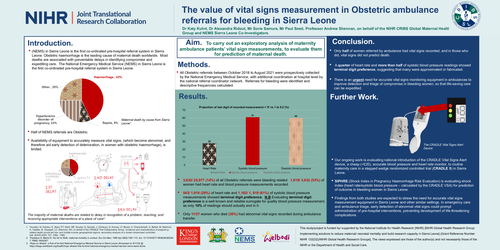
•(NEMS) in Sierra Leone is the first co-ordinated pre-hospital referral system in Sierra Leone. Obstetric haemorrhage is the leading cause of maternal death worldwide. Most deaths are associated with preventable delays in identifying compromise and expediting care. The National Emergency Medical Service (NEMS) in Sierra Leone is the first co-ordinated pre-hospital referral system in Sierra Leone.
•Half of NEMS referrals are Obstetric.
•Availability of equipment to accurately measure vital signs, (which become abnormal, and therefore aid early detection of deterioration, in women with obstetric haemorrhage), is limited.
Aim
To carry out an exploratory analysis of maternity ambulance patients’ vital sign measurements, to evaluate them for prediction of maternal death.
Methods
•All Obstetric referrals between October 2018 to August 2021 were prospectively collected by the National Emergency Medical Service, with additional coordination at hospital level by the national referral coordinator network. Referrals for bleeding were identified and descriptive frequencies calculated.
Results
•3,632/ 25,977 (14%) of all Obstetric referrals were bleeding related. 1,919/ 3,632 (53%) of women had heart rate and blood pressure measurements recorded.
•543/ 1,919 (28%) of heart rate and 1,162/ 1, 919 (61%) of systolic blood pressure measurements showed terminal digit preference. N.B Evaluating terminal digit preference is a well known and reliable surrogate for quality blood pressure measurement, as only 10% of readings should actually end in 0.
•Only 11/37 women who died (30%) had abnormal vital signs recorded during ambulance transfer.
Conclusion
•Only half of women referred by ambulance had vital signs recorded, and in those who did, vital signs did not predict death.
• A quarter of heart rate and more than half of systolic blood pressure readings showed terminal digit preference, suggesting that many were approximated or fabricated.
•There is an urgent need for accurate vital signs monitoring equipment in ambulances to improve detection and triage of compromise in bleeding women, so that life-saving care can be expedited.
Further work
•Our ongoing work is evaluating national introduction of the CRADLE Vital Signs Alert device, a cheap (<£20), accurate blood pressure and heart rate monitor, to routine maternity care in a stepped wedge randomized controlled trial (CRADLE 5) in Sierra Leone.
•SIPHRE (Shock Index in Pregnancy Haemorrhage Risk Evaluation) is evaluating shock index (heart rate/systolic blood pressure – calculated by the CRADLE VSA) for prediction of outcome in bleeding women in Sierra Leone.
•Findings from both studies are expected to stress the need for accurate vital signs measurement equipment in Sierra Leone and other similar settings. In emergency care and ambulance triage, early detection of abnormal vital signs could prompt administration of pre-hospital interventions, preventing development of life-threatening complications.