1,830 posters, 67 videos, 75 audios, 29 topics, 22 sessions, 4,727 authors, 1,697 institutions
ePostersLive by SciGen Technologies S.A. All rights reserved.
RCOG World Congress 2023
June 12 - 14, 2023 | London, UK

PP.0129
Post Caesarean section wound infection audit, Multidisciplinary management and its challenges
Poster Presenter
Authors
Affiliations
Part of Topic
Hot Topics (Emerging research/issues) in Obstetrics
Wound Infection after Caesarean sections
Dr MohamAd Ismail, Dr Mohammad Mahmoud and Ms Sadia Ijaz
Russell's Hall Hospital- Dudley West Midland
Objective
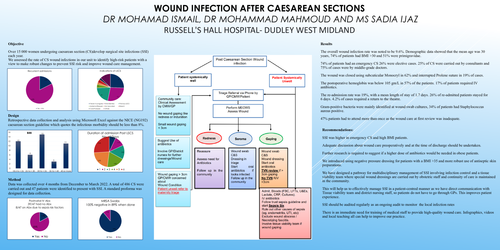
Over 15 000 women undergoing caesarean section (CS)develop surgical site infections (SSI) each year.
We assessed the rate of CS wound infections in our unit to identify high-risk patients with a view to make robust changes to prevent SSI risk and improve wound care management.
Design
Retrospective data collection and analysis using Microsoft Excel against the NICE (NG192) caesarean section guideline which quotes the infectious morbidity should be less than 8%.
Method
Data was collected over 4 months from December to March 2022. A total of 486 CS were carried out and 47 patients were identified to present with SSI. A standard proforma was designed for data collection.
Results
The overall wound infection rate was noted to be 9.6%. Demographic data showed that the mean age was 30 years, 74% of patients had BMI >30 and 51% were primigravidae.
74% of patients had an emergency CS 26% were elective cases. 25% of CS were carried out by consultants and 75% of cases were by middle-grade doctors.
The wound was closed using subcuticular Monocryl in 62% and interrupted Prolene suture in 19% of cases.
The postoperative hemoglobin was below 105 gm/L in 57% of the patients. 17% of patients required IV antibiotics.
The re-admission rate was 19%, with a mean length of stay of 1.7 days. 26% of re-admitted patients stayed for 6 days. 4.2% of cases required a return to the theatre.
Gram-positive bacteria were mainly identified at wound swab cultures, 34% of patients had Staphylococcus aureus positive.
47% patients had to attend more than once as the wound care at first review was inadequate.
Recommendations:
SSI was higher in emergency CS and high BMI patients.
Adequate discussion about wound care preoperatively and at the time of discharge should be undertaken.
Further research is required to suggest if a higher dose of antibiotics would be needed in obese patients.
We introduced using negative pressure dressing for patients with a BMI >35 and more robust use of antiseptic skin preparations.
We have designed a pathway for multidisciplinary management of SSI involving infection control and a tissue viability team where special wound dressings are carried out by obstetric staff and continuity of care is maintained in the community.
This will help us to effectively manage SSI in a patient-centred manner as we have direct communication with Tissue viability team and district nursing staff, so patients do not have to go through GPs. This improves patient experience.
SSI should be audited regularly as an ongoing audit to monitor the local infection rates
There is an immediate need for training of medical staff to provide high-quality wound care. Infographics, videos and local teaching all can help to improve our practice.