1,830 posters, 67 videos, 75 audios, 29 topics, 22 sessions, 4,727 authors, 1,697 institutions
ePostersLive by SciGen Technologies S.A. All rights reserved.
RCOG World Congress 2023
June 12 - 14, 2023 | London, UK

EP.0177
A dedicated Breech Clinic Service: Evaluation of outcomes and patient perceptions
Poster Presenter
Part of Topic
Fetal Medicine
Abstract:
Objectives: To determine the success, outcomes and patient perceptions of External Cephalic Version (ECV) delivered in a dedicated breech service.
Design: This was a retrospective study of pregnant patients who received antenatal care in a dedicated breech clinic service from October 2018 to October 2022 in a busy London Maternity Hospital.
Methods: 488 patients were managed in the breech clinic. Of these, 49 (10%) spontaneously reverted to cephalic presentation and did not require ECV. 439 patients underwent ECV and were included. Routine data was collected for analysis and a patient satisfaction survey was conducted.
Results: ECV success was 62% overall, 52% in nulliparous women and 85% in multiparous women, which is higher than the quoted national standard. This was increased to 74%, 63% and 92% respectively in flexed breech presentation. Patients with a body mass index >35 had a lower success rate at 50%. There was a 1.5% rate of reversion to breech presentation after successful ECV. Of successful ECVs, 75% of patients had a vaginal delivery. Complication rates were low; 2 patients (0.46%) required emergency Caesarean for foetal distress and there was 1 reported case of significant haemorrhage. The average breech service satisfaction score was high at 9.8/10. The average ECV pain score was moderate at 4.3/10.
Conclusions: A dedicated breech clinic with experienced operators may increase ECV success rates and has high patient satisfaction. There is a higher rate of successful ECV with flexed breech than extended breech. Rates of reversion to breech following successful ECV are low. Patients opting for an ECV should be aware that the pain associated with ECV is likely to be moderate.
Audit standards [1]
Following the publication of the Term Breech Trial (2000)[2], many European countries have seen a considerable increase in the rate of Caesarean section for breech presentation. Dedicated breech clinics aimed at increasing the uptake and success of external cephalic version (ECV) have been proposed as a solution to reducing Caesarean section rates[3]. Though most obstetricians and midwives consider ECV safe and cost-effective, its uptake amongst eligible women often falls short. Varying figures below 50% uptake are quoted in the literature[4,5] .
The barriers to low ECV uptake and provision comprise both patient and operator factors. These include low acceptability amongst women due to physical pain[6], viewing ECV as a ‘last resort’ after alternatives/adjuncts such as moxibustion and maternal positioning[7], a generally negative perception of ECV on the internet/social media[7], a lack of individualised counselling[7] and the operator’s own perception of their skill[8].
This audit analysed 4-year data from a breech clinic in a tertiary centre against RCOG standards[1] , to determine the success rates, outcomes and patient perceptions of ECV. Our aim was to compare the performance of a specialist service to the national average, provide future patients with in-depth, centre-specific counselling to facilitate their decision-making and to determine whether a dedicated breech service helps overcome the obstacles to ECV uptake and provision.
Methods
This was a single-centre retrospective study. Demographic and clinical data was obtained from electronic patient records and routine appointments at breech clinic over the 48-month period between October 2018 and October 2022 and comprises 488 patients seen in clinic. Of these, 49 did not opt for ECV due to spontaneous cephalic version after breech detection. 439 patients underwent ECV and were included in the study. Where patients did not have all relevant data, their data was not used in that calculation. All data was analysed, and all graphs were generated using the Microsoft Excel statistical package.
Results
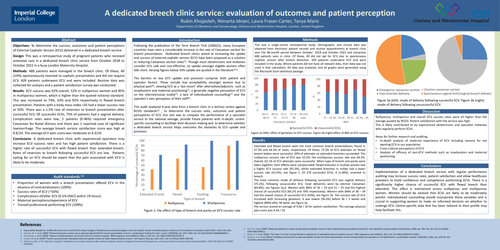
Extended and flexed breech were the most common breech presentations, found in 47.3% and 44.3% of cases, respectively. Of these, 73.5% of ECV attempts on flexed breech babies were successful. 49% of attempts on extended breeches succeeded. The nulliparous success rate of ECV was 52.5%; the multiparous success rate was 84.5%. Overall, 62.1% of ECV attempts were successful. When type of breech and parity were taken together, their effects were compounded; flexed breeches in multips women had a higher ECV success rate (92.3%), whilst extended breeches in nullips had a lower success rate (41.6%), see figure 1. Of 270 successful ECVs, 4 (1.48%), reverted to breech.
The most common mode of delivery following successful ECV was vaginal delivery (75.1%); following unsuccessful ECV, most deliveries were by elective Caesarean (69.8%), see figures 2a,b. Women with BMIs of 16 – 19 and 31 – 35 had the highest chance of successful ECV (64.2% and 70% respectively). Women with BMIs of 36 – 39 had the lowest chance of successful ECV (50%), see figure 2b. The success rate of ECV increased with increasing gestation; it was lowest (56.4%) before 36 + 3 weeks and highest (80%) after 38 week, see figure 2a.
The service scored an average of 9.84 / 10 for patient satisfaction. The average physical pain score was 4.34 / 10.
Discussion
Nulliparous, multiparous and overall ECV success rates were all higher than the average quoted by RCOG. Patient satisfaction with the service was high.
This is likely contributed to by experienced obstetricians and specialist midwives who regularly perform ECVs.
Areas for further research and auditing:
Conclusion
Implementation of a dedicated breech service with regular performance auditing may increase success rates, patient satisfaction and allow healthcare providers to build confidence and competence performing ECVs. There is a significantly higher chance of successful ECV with flexed breech than extended. This effect is maintained across nulliparous and multiparous women. Women should be advised that ECVs are likely to be moderately painful. Individualised counselling should incorporate these variables and is crucial in supporting women to make an informed decision on whether to undergo ECV. Centre-specific data that has been tailored to their profile may help facilitate this.