Loading...

1,830 posters, 67 videos, 75 audios, 29 topics, 22 sessions, 4,727 authors, 1,697 institutions

ePostersLive by SciGen Technologies S.A. All rights reserved.

RCOG World Congress 2023

June 12 - 14, 2023 | London, UK

RCOG World Congress 2023 banner

PP.0104

The Impact of Abnormal Maternal Body Mass Index on Perinatal Outcome
Part of Topic

Obesity

Introduction

According to the World Health Organization (WHO), obesity is one of the most significant global health issues of the  21st century due to the alarming rise in prevalence 1.Abnormal Body mass index (BMI) during pregnancy is a growing public health concern as it has been associated with an increased risk of maternal and neonatal complications.
Maternal risks associated with obesity include gestational diabetes mellitus (GDM), gestational hypertension (GHT), intrapartum complications, and postpartum complications 2.Fetal risks associated with obesity include birth abnormalities, macrosomia, unexplained stillbirths, admission to the neonatal intensive care unit (NICU), and neonatal fatalities 2.

Less research has been targeted at the effect of maternal underweight, which is associated with adverse neonatal outcomes.


Aim

This study aimed to investigate the impact of abnormal (low & high) BMI on maternal and neonatal outcomes compared to normal BMI.
 

Methodology

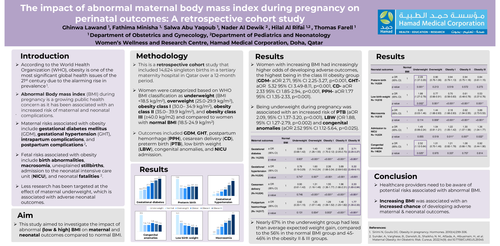
This is a retrospective cohort study that included 14,624 singleton births in a tertiary maternity hospital in Qatar over a 12-month period.

Women were categorized based on WHO BMI classification as underweight (BMI <18.5 kg/m2), overweight (25.0-29.9 kg/m2), obesity class I (30.0– 34.9 kg/m2), obesity class II (35.0– 39.9 kg/m2), and obesity class III (≥40.0 kg/m2) and compared to women with normal BMI (18.5-24.9 kg/m2)

Outcomes included GDM, GHT, postpartum hemorrhage (PPH), cesarean delivery (CD), preterm birth (PTB), low birth weight (LBW), congenital anomalies, and NICU admission.


Results

Women with increasing BMI had increasingly higher odds of developing adverse outcomes, the highest being in the class III obesity group (GDM- aOR 2.71, 95% CI 2.25-3.27, p<0.001, GHT- aOR  5.32 95% CI 3.49-8.11, p<0.001, CD- aOR 2.33 95% CI 1.85-2.94, p<0.001, PPH- aOR 1.77 95% CI 1.35-2.33, p<0.001).

Being underweight during pregnancy was associated with an increased risk of PTB (aOR 2.09, 95% CI 1.37-3.20, p=0.001), LBW (OR 1.88, 95% CI 1.27-2.79, p=0.002) and congenital anomalies (aOR 2.52 95% CI 1.12-5.64, p=0.025).

Nearly 67% in the underweight group had less than average expected weight gain, compared to the 56% in the normal BMI group and 45-46% in the obesity II & III groups.


Conclusion

Healthcare providers need to be aware of potential risks associated with abnormal BMI.
Increasing BMI was associated with an increased chance of developing adverse maternal & neonatal outcomes.


RCOG World Congress 2023 » banner
Copyright © 2015-2026, ePostersLive® SciGen is a registered trademark of SciGen Technologies S.A. Patent pending.

This website and third-party tools we use rely on cookies for the best user experience. By selecting "I agree", you agree to cookie usage as described in our Privacy Policy.