1,830 posters, 67 videos, 75 audios, 29 topics, 22 sessions, 4,727 authors, 1,697 institutions
ePostersLive by SciGen Technologies S.A. All rights reserved.
RCOG World Congress 2023
June 12 - 14, 2023 | London, UK

PP.0103
Second and third trimester HbA1c levels in large for gestational age neonates?
Poster Presenter
Authors
Affiliations
Part of Topic
Maternal Medicine
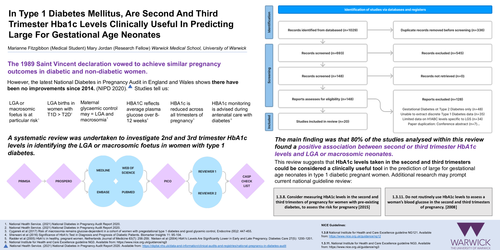
In Type 1 Diabetes Mellitus, Are Second And Third Trimester Hba1c Levels Clinically Useful In Predicting Large For Gestational Age Neonates
The 1989 Saint Vincent declaration vowed to achieve similar pregnancy outcomes in diabetic and non-diabetic women.
However, the latest National Diabetes in Pregnancy Audit in England and Wales shows there have been no improvements since 2014. (NIPD 2020).
Studies tell us:
LGA or macrosomic foetus is at particular risk
LGA births in women with T1D > T2D
Maternal glycaemic control may = LGA and macrosomia
HBA1C reflects average plasma glucose over 8-12 weeks
HBA1c is reduced across all trimesters of pregnancy
HBA1c monitoring is advised during antenatal care with diabetes
A systematic review was undertaken to investigate 2nd and 3rd trimester HbA1c levels in identifying the LGA or macrosomic foetus in women with type 1 diabetes.
The main finding was that 80% of the studies analysed within this review found a positive association between second or third trimester HbA1c levels and LGA or macrosomic neonates.
This review suggests that HbA1c levels taken in the second and third trimesters could be considered a clinically useful tool in the prediction of large for gestational age neonates in type 1 diabetic pregnant women. Additional research may prompt current national guideline review:
1.3.8. Consider measuring HbA1c levels in the second and third trimesters of pregnancy for women with pre-existing diabetes, to assess the risk for pregnancy [2015]
1.3.11. Do not routinely use HbA1c levels to assess a woman’s blood glucose in the second and third trimesters of pregnancy. [2008]