1,830 posters, 67 videos, 75 audios, 29 topics, 22 sessions, 4,727 authors, 1,697 institutions
ePostersLive by SciGen Technologies S.A. All rights reserved.
RCOG World Congress 2023
June 12 - 14, 2023 | London, UK

PP.0098
Progesterone rescue in women with low levels around the embryo transfer day
Poster Presenter
Authors
Konstantinos Stavridis, Stavroula-Lila Kastora, Olga Triantafyllidou, Dimitrios Mavrelos, Nikolaos Vlahos
Affiliations
2nd Department of Obstetrics and Gynecology, “Aretaieion” University Hospital, EGA Institute for Women’s Health; University College London; Room G15; 86-96 Chenies Mews; London; WC1E 6HX
Part of Topic
Reproductive Medicine/Assisted Reproduction
Audio
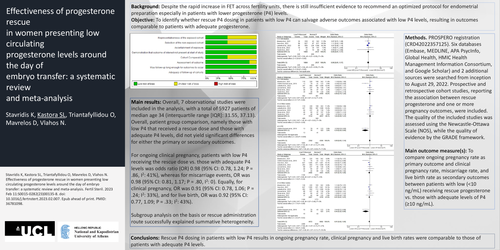
Effectiveness of progesterone rescue in women presenting low circulating progesterone levels around the day of embryo transfer: a systematic review and meta-analysis
Background: Despite the rapid increase in FET across fertility units, there is still insufficient evidence to recommend an optimized protocol for endometrial preparation, especially in patients with lower progesterone (P4) levels.
Objective: To identify whether rescue P4 dosing in patients with low P4 can salvage adverse outcomes associated with low P4 levels, resulting in outcomes comparable to patients with adequate progesterone.
Methods. PROSPERO registration (CRD42022357125). Six databases (Embase, MEDLINE, APA PsycInfo, Global Health, HMIC Health Management Information Consortium, and Google Scholar) and 2 additional sources were searched from inception to August 29, 2022. Prospective and retrospective cohort studies, reporting the association between rescue progesterone and one or more pregnancy outcomes, were included. The quality of the included studies was assessed using the Newcastle-Ottawa Scale (NOS), while the quality of evidence by the GRADE framework.
Main outcome measure(s): To compare ongoing pregnancy rate as primary outcome and clinical pregnancy rate, miscarriage rate, and live birth rate as secondary outcomes between patients with low (<10 ng/mL) receiving rescue progesterone vs. those with adequate levels of P4 (≥10 ng/mL).
Main results: Overall, 7 observational studies were included in the analysis, with a total of 5927 patients of median age 34 (interquartile range [IQR]: 31.55, 37.13). Overall, patient group comparison, namely those with low P4 that received a rescue dose and those with adequate P4 levels, did not yield significant differences for either the primary or secondary outcomes. For ongoing clinical pregnancy, patients with low P4 receiving the rescue dose vs. those with adequate P4 levels was odds ratio (OR) 0.98 (95% CI: 0.78, 1.24; P = .86, I2: 41%), whereas for miscarriage events, OR was 0.98 (95% CI: 0.81, 1.17; P = .80, I2: 0). Equally, for clinical pregnancy, OR was 0.91 (95% CI: 0.78, 1.06; P = .24; I2: 33%), and for live birth, OR was 0.92 (95% CI: 0.77, 1.09; P = .33; I2: 43%). Subgroup analysis on the basis or rescue administration route successfully explained summative heterogeneity.
Conclusions: Rescue P4 dosing in patients with low P4 results in ongoing pregnancy rate, clinical pregnancy and live birth rates were comparable to those of patients with adequate P4 levels.