1,830 posters, 67 videos, 75 audios, 29 topics, 22 sessions, 4,727 authors, 1,697 institutions
ePostersLive by SciGen Technologies S.A. All rights reserved.
RCOG World Congress 2023
June 12 - 14, 2023 | London, UK

PP.0095
Placental-growth-factor (PlGF) and Pre-eclampsia (PET) ratio: A determinant of maternal & fetal outcomes?
Poster Presenter
Part of Topic
Hot Topics (Emerging research/issues) in Obstetrics
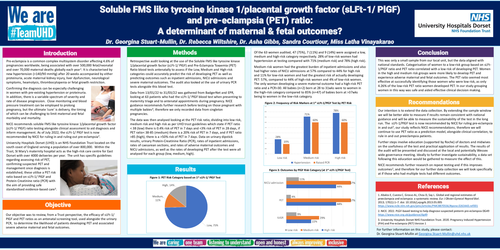
Soluble FMS like tyrosine kinase 1/placental growth factor (sLFt-1/ PlGF) and pre-eclampsia (PET) ratio: A determinant of maternal & fetal outcomes?
Dr. Georgina Stuart-Mullin, Dr. Rebecca Wiltshire, Dr. Asha Gibbs, Sandra Courtiour, Miss Latha Vinayakarao
Introduction
Pre-eclampsia is a common complex multisystem disorder affecting 4.6% of pregnancies worldwide, being associated with over 500,000 fetal/neonatal and over 70,000 maternal deaths globally each year1 . It is characterised by new hypertension (>140/90 mmHg) after 20 weeks accompanied by either proteinuria, acute maternal kidney injury, liver dysfunction, neurological symptoms, heamolysis, thrombocytopenia or fetal growth restriction. Confirming the diagnosis can be especially challenging in women with pre-existing hypertension or proteinuria. In addition, there is a variable spectrum of severity and rate of disease progression. Close monitoring and blood pressure treatment can be employed to prolong pregnancy, but the ultimate ‘cure’ is delivery, the timing of which can be challenging to limit maternal and fetal morbidity and mortality. NICE recommends soluble FMS like tyrosine kinase 1/placental growth factor (sLFt-1/ PlGF) ratio testing alongside clinical assessment to aid diagnosis and inform management. As of July 2022, the sLFt-1/ PlGF test is now recommended by NICE for ruling in and ruling out pre-eclampsia2 . University Hospitals Dorset (UHD) is an NHS Foundation Trust located on the south coast of England serving a population of over 800,000. Within the Trust, St Mary’s maternity hospital acts as the high-risk care centre for East Dorset with over 4000 deliveries per year. The unit has specific guidelines regarding assessing risk of PET, confirming suspected PET and management once diagnosis is established, these utilise a PET risk ratio based on sLFt-1/ PlGF and Protein Creatinine ratio (PCR) with the aim of providing safe standardised evidence-based care.3
Objective
Our objective was to review, from a Trust perspective, the efficacy of sLFt-1/ PlGF and PET ratios as an antenatal screening tool, used alongside the urinary PCR, to determine the likelihood of patients developing PET and associated severe adverse maternal and fetal outcomes.
Methods
Retrospective audit looking at the use of the Soluble FMS like tyrosine kinase 1/placental growth factor (sLFt-1/ PlGF) and Pre-Eclampsia Toxaemia (PET) Ratio blood tests antenatally to assess if the Low, Medium and High-risk categories could accurately predict the risk of developing PET as well as predicting outcomes such as inpatient admissions, NICU admissions and severe maternal outcomes. The audit also looked at the use of urinary PCR tests alongside this blood test. Data from 13/01/22 to 31/03/22 was gathered from BadgerNet and EPR, looking at 63 patients who had the sLFt-1/ PlGF blood test when presenting to maternity triage and to antenatal appointments during pregnancy. NICE guidance recommends further research before testing on those pregnant with multiple babies 4 , therefore we only recorded data from singleton pregnancies. The data was then analysed looking at the PET risk ratio, dividing into low risk, medium risk and high risk as per UHD trust guidelines which state if PET ratio < 38 (low) there is 0.4% risk of PET in 7 days and <3% risk of PET in 28 days, if PET ratio< 38-85 (medium) there is a 20% risk of PET in 7 days, and if PET ratio >85 (high), there is a >50% risk of PET in 7 days. Data on urinary dipstick results, urinary Protein-Creatinine Ratio (PCR), rates of inpatient admissions, rates of caesarean sections, and rates of adverse maternal outcomes and NICU admissions, as well as the rates of developing PET after the test were all analysed for each group (low, medium, high).
Results
Of the 63 women audited, 47 (75%), 7 (11%) and 9 (14%) were assigned a low, medium and high-risk category respectively. 28% of low-risk women had hypertension at testing compared with 71% (medium risk) and 78% (high risk). Medium risk women had the greatest burden of inpatient admissions and also had higher rates of NICU admissions at 57% compared to 44% for high risk and 11% for low-risk women and had the greatest risk of actually developing PET: 57%, compared to 44% of high-risk women and 4% of low-risk women. The only woman developing a severe maternal outcome had a high-risk PET ratio and a PCR>30. All babies (n=2) born at 28 to 31wks were to women in the high-risk category compared to 85% (n=47) of babies born at >37wks being to women in the low-risk category.
Conclusion
This was only a small sample from our local unit, but the data aligned with national standards. Categorisation of women to a low-risk group based on sLFt1/PlGF ratio and PET ratio correlated with a low risk of developing PET. Women in the high and medium risk groups were more likely to develop PET and experience adverse maternal and fetal outcomes. The PET ratio seemed most effective at successfully identifying those women who were low risk, as only 4.26% of the low-risk PET ratio women developed PET. In our study grouping women in this way was safe and aided effective clinical decision making.
Recommendations
Our intention is to extend the data collection. By extending the sample window we will be better able to measure if results remain consistent with national guidance and will be able to measure the sustainability of the test in the long run. The sLFt-1/PlGF test is now recommended by NICE for ruling pre-eclampsia in and out 2 , our study reflects NICE recommendations, therefore we will continue to use PET ratio as a prediction model, alongside clinical correlation, to rule in and out preeclampsia patients. Further steps involve education (supported by Roche) of doctors and midwives on the usefulness of the test and practical application of results. The results of the audit will be presented and discussed at the local and potentially Wessex wide governance meeting. Ideally to further investigate sustainability, a data set following this education would be gathered to measure the effect of this. NICE recommends further research on repeat testing and if this improves outcomes 2 , and therefore for our further data collection we will look specifically at if those who had multiple tests had different outcomes.