1,830 posters, 67 videos, 75 audios, 29 topics, 22 sessions, 4,727 authors, 1,697 institutions
ePostersLive by SciGen Technologies S.A. All rights reserved.
RCOG World Congress 2023
June 12 - 14, 2023 | London, UK

PP.0094
Is Myoinositol effective in preventing gestational diabetes mellitus?
Poster Presenter
Part of Topic
Maternal Medicine
Is Myoinositol effective in preventing gestational diabetes mellitus?
Abstract:
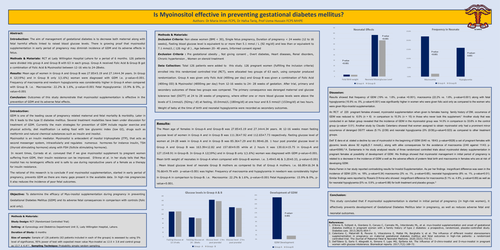
Introduction: The aim of management of gestational diabetes is to decrease both maternal along with fetal harmful effects linked to raised blood glucose levels. There is growing proof that myoinositol supplementation in early period of pregnancy may diminish incidence of GDM and its adverse effects in fetus.
Methods & Materials: RCT at Lady Willingdon Hospital Lahore for a period of 6 months. 126 patients were divided into group A and Group B with 63 in each group. Group A received Folic Acid & Group B got a combination of Folic Acid & Myoinositol between 12-16 wks to 24-28wks.
Results: Mean age of women in Group A and Group B was 27.85±5.19 and 27.14±4.34 years. In Group A 12(19%) and in Group B only 1(1.6%) woman were diagnosed with GDM i.e. p-value=0.001. Frequency of macrosomia and newborn hypoglycemia was considerably higher in Group A when compared with Group B. i.e. Macrosomia: 22.2% & 1.6%, p-value<0.001 Fetal Hypoglycemia: 15.9% & 0%, p-value=0.001
Conclusion: Outcomes of this study demonstrate that myoinositol supplementation is effective in the prevention of GDM and its adverse fetal effects.
Introdcution:
GDM is one of the leading cause of pregnancy related maternal and fetal mortality & morbidity. Later in life it leads to the type II diabetes mellitus. Several treatment modalities have been under discussion for treatment of GDM. Currently the main strategies for prevention of GDM include regular exercise and physical activity, diet modification i.e eating food with low glycemic index (low GI), drugs such as metformin and natural chemical substances such as insulin and inositol.
Myoinositol is an insulin mediator. Myoinositol is antecedent of inositol triphosphate (ITP), that acts as second messenger system, intracellularly and regulates numerous hormones for instance insulin, TSH (thyroid stimulating hormone) along with FSH (follicle stimulating hormone).
In recent times, Corrado et al. conveyed that if we give myoinositol supplement to pregnant women suffering from GDM, their insulin resistance can be improved. D’Anna et al. in her study tells that Myo inositol has no teratogenic effects and is safe to use during reproductive years of a female as a therapy for insulin resistance.
The rational of this research is to conclude if oral myoinositol supplementation, started in early period of pregnancy, prevents GDM as there are many gaps present in the available data. In high-risk pregnancies it also reduces the incidence of poor fetal outcomes.
Objective: To determine the efficacy of Myo-inositol supplementation during pregnancy in preventing Gestational Diabetes Mellitus (GDM) and its adverse fetal consequences in comparison with controls (folic acid only).
Methods & Materials:
Study Design: RCT (Randomized Controlled Trial)
Setting: at Gynecology and Obstetrics Department Unit II, Lady Willingdon Hospital, Lahore.
Duration of Study: 6 months
Size of sample: Sample of 126 patients (63 patients included in each of the groups) is assessed by using 5% level of significance, 95% power of test with expected mean value Myo-inositol as 12.0 ± 3.8 and control group as 13.7 ± 4.4(1) . Sampling Technique: Probability simple random sampling.
Methods & Materials:
Inclusion Criteria: Non obese women (BMI < 30), Single fetus pregnancy, Duration of pregnancy < 24 weeks (12 to 16 weeks), Fasting blood glucose level is equivalent to or more than 5.1 mmol / L (92 mg/dl) and less than or equivalent to 7.1 mmol/L ( 126 mg/ dl ) , Age between 20- 40 years, Informed consent signed
Exclusion Criteria : Pre gestational obesity , Not giving consent , Overt diabetes, Heart diseases, Renal disorders, Chronic hypertension , Women on steroid treatment
Data Collection: Total 126 patients were added to this study. 126 pregnant women (fulfilling the inclusion criteria) enrolled into this randomized controlled trial (RCT), were allocated two groups of 63 each, using computer produced randomization. Group A was given only Folic Acid (400mg per day) and Group B was given a combination of Folic Acid (400mg OD) & Myoinositol (4000mg per day) from 12-16 weeks to 24- 28 weeks of gestation. After trial, primary and secondary outcomes of these two groups was compared. The primary consequence was deranged maternal oral glucose tolerance test (OGTT) at 24 to 28 weeks of pregnancy, where either one or more blood glucose levels were above the levels of 5.1mmol/L (92mg / dl) at fasting, 10.0mmol/L (180mg/dl) at one hour and 8.5 mmol/l (153mg/dl) at two hours. Weight of baby at the time of birth and neonatal hypoglycemia were recorded as secondary outcomes.
Results:
The Mean age of females in Group-A and Group-B was 27.85±5.19 and 27.14±4.34 years. At 12-16 weeks mean fasting glucose level of women in Group A and in Group B was 111.36±7.92 and 112.65±7.73respectively. Fasting glucose level of women at 24-28 week in Group A and in Group B was 85.36±7.29 and 81.98±6.28. 1 hour post prandial glucose level in Group A and Group B was 163.39±12.82 and 157.60±9.05 while at 2 hours it was 130.61±15.75 in Group-A and 127.15±8.91 in Group-B. In Group A 12(19%) and in Group B only 1(1.6%) woman was diagnosed with GDM p-value=0.001. Mean birth weight of neonates in Group-A when compared with Group-B women. i.e. 3.49±0.46 & 3.20±0.33, p-value<0.001 . Mean blood glucose level of neonate Group B mothers as compared to that of Group A mothers. i.e. 66.80±16.34 & 76.66±9.79 with p-value<0.001 was higher. Frequency of macrosomia and hypoglycemia in newborn was considerably higher in Group-A in comparison to Group-B. i.e. Macrosomia: 22.2% & 1.6%, p-value<0.001 Fetal Hypoglycemia: 15.9% & 0%, p-value=0.001.
Disussion:
Results showed that frequency of GDM (19% vs. 1.6%, p-value =0.001), macrosomia (22.2% vs. 1.6%, p-value<0.001) along with fetal hypoglycemia (15.9% vs. 0%, p-value=0.001) was significantly higher in women who were given folic acid only as compared to the women who were given Myo-inositol supplementation.
An RCT of 220 pregnant females showed, myoinositol supplementation when given to females having family history of DM, occurrence of GDM was reduced to 6.0% (n = 6) in comparison to 15.3% (n = 15) in those who never took this supplement.1 Another study that was conducted in an Italian group revealed that the incidence of GDM in the myoinositol group was 14.0% in comparison to 33.6% in the control group (p-value= 0.01). Another study by Claudio Celentano showed that women assigned to obtain myoinositol only had a prominent minor occurrence of deranged OGTT values (5.1% (2/39) and neonatal hypoglycemia (0% (0/39),p-value=0.023) as compared to other treatment groups.
Dell’ E dera et al. stated a decline by use of myoinositol in the beginning of GDM (5/40 vs. 18/43; p-value=0028) a set of pregnant females with glycemic levels above 92 mg/dL(5.1 mmol/L), along with alike consequences for the avoidance of macrosomia (2/40 against 11/43; p-value=0099).2 A. Santamaria in his study analyzed results of three randomized controlled trials about myoinositol dietary supplementation in pregnant females at possibility of development of GDM. His findings showed that myoinositol management in initial period of pregnancy is related to a decrease in the incidence of GDM a well as the adverse effects of preterm fetal birth and macrosomia in females who are at risk of developing GDM.
Maria Farren in her study reported contradicting results for Inositol Supplementation. As per her findings insignificant difference was seen in the incidence of GDM (23% vs. 18%, p-value=0.34) macrosomia (3% vs. 1%, p-value=0.65), neonatal hypoglycemia (8% vs. 1%, p-value=0.01). Similar findings were reported by Rosario D’Anna who showed insignificant difference for macrosomia (5.1% vs. 4.8%, p-value=0.89) as well as for neonatal hypoglycemia (0% vs. 0.9%, p-value=0.88) for both treatment and placebo groups.3
Conclusion:
This study concluded that if myoinositol supplementation is started in initial period of pregnancy (in high-risk women), it effectively prevents development of Gestational Diabetes Mellitus later in pregnancy, as well as reduces adverse fetal and neonatal outcomes.
References: