1,830 posters, 67 videos, 75 audios, 29 topics, 22 sessions, 4,727 authors, 1,697 institutions
ePostersLive by SciGen Technologies S.A. All rights reserved.
RCOG World Congress 2023
June 12 - 14, 2023 | London, UK

PP.0081
Management of intrauterine death with placenta previa
Poster Presenter
Part of Topic
Labour Ward Management
Introduction
-Placenta previa is defined as the encroachment of the placenta on the cervical os1.
-It is a common cause of obstetric haemorrhage1.
-A guideline regarding the management of intrauterine death (IUD) in patients with placenta previa has not been fully elucidated and poses a dilemma for obstetricians.
Case Description
-A 35-year-old primigravid with a 5-year history of subfertility.
-Normal Booking bloods, negative serology and low-risk CST.
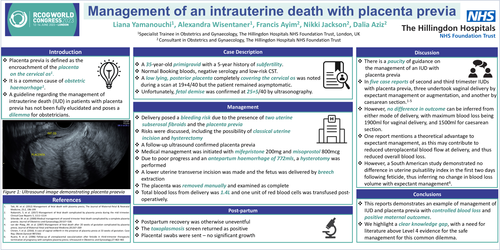
-A low lying, posterior placenta completely covering the cervical os was noted during a scan at 19+4/40 but the patient remained asymptomatic.
- Unfortunately, fetal demise was confirmed at 25+5/40 by ultrasonography.
Management
-Delivery posed a bleeding risk due to the presence of two uterine subserosal fibroids and the placenta previa
-Risks were discussed, including the possibility of classical uterine incision and hysterectomy
-A follow-up ultrasound confirmed placenta previa
-Medical management was initiated with mifepristone 200mg and misoprostol 800mcg
-Due to poor progress and an antepartum haemorrhage of 772mls, a hysterotomy was performed
-A lower uterine transverse incision was made and the fetus was delivered by breech extraction
-The placenta was removed manually and examined as complete
-Total blood loss from delivery was 1.4L and one unit of red blood cells was transfused post-operatively.
Post-partum
-Postpartum recovery was otherwise uneventful
-The toxoplasmosis screen returned as positive
-Placental swabs were sent – no significant growth
Discussion
-There is a paucity of guidance on the management of an IUD with placenta previa
-In five case reports of second and third trimester IUDs with placenta previa, three undertook vaginal delivery by expectant management or augmentation, and another by caesarean section.1-5
-However, no difference in outcome can be inferred from either mode of delivery, with maximum blood loss being 1900ml for vaginal delivery, and 1500ml for caesarean section.
-One report mentions a theoretical advantage to expectant management, as this may contribute to reduced uteroplacental blood flow at delivery, and thus reduced overall blood loss.
-However, a South American study demonstrated no difference in uterine pulsatility index in the first two days following feticide, thus inferring no change in blood loss volume with expectant management6.
Conclusions
-This reports demonstrates an example of management of IUD and placenta previa with controlled blood loss and positive maternal outcomes.
-We highlight a clear knowledge gap, with a need for literature above Level 4 evidence for the safe management for this common dilemma.
References
1.Taki, M. et al. (2012) Management of fetal death with placenta previa, The Journal of Maternal-Fetal & Neonatal Medicine, 25:2, 196-199
2.Nakanishi, S. et al. (2017) Management of fetal death complicated by placenta previa during the mid trimester. Clinical Case Reports 5, 1111–1114
3.Sillender, M. et al. (2000) Medical management of second trimester fetal death complicated by a complete placenta praevia. Journal of Obstetrics and Gynaecology;20:537–538.
4.van der Ploeg, JM. et al. (2007) Management of fetal death after 20 weeks of gestation complicated by placenta previa. Journal of Maternal-Fetal and Neonatal Medicine;20:267–269
5.Chinen, Y. et al. (2016). A case of vaginal stillbirth in the presence of placenta previa at 33 weeks of gestation. Case Rep. Obstet.Gynecol:9872561
6.Ruano, R. et al. (2006) Follow-up of uteroplacental vascularization after feticide in third-trimester therapeutic termination of pregnancy with complete placenta previa. Ultrasound in Obstetrics and Gynecology;27:463–465