1,830 posters, 67 videos, 75 audios, 29 topics, 22 sessions, 4,727 authors, 1,697 institutions
ePostersLive by SciGen Technologies S.A. All rights reserved.
RCOG World Congress 2023
June 12 - 14, 2023 | London, UK

EP.0173
Caesarean Section Outcomes in Women with Morbid Obesity
Poster Presenter
Authors
Muhammad Sharique, Maria Soofi, Eleanor Jarvie, Mihai Gherghe
Affiliations
Part of Topic
Obesity
Audio
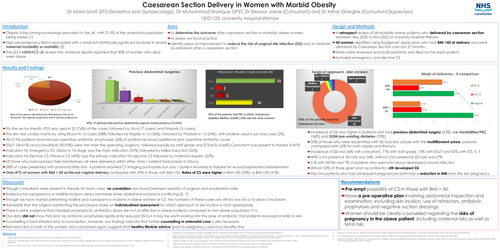
Caesarean Section Delivery in Women with Morbid Obesity Dr Maria Soofi (ST5 Obstetrics and Gynaecology), Dr Muhammad Sharique GPST, Dr Eleanor Jarvie (Consultant) and Dr Mihai Gherghe (Consultant/Supervisor) 18/01/23, University Hospital Wishaw Introduction Obesity is becoming increasingly prevalent in the UK, with 21.3% of the antenatal population being obese [1] High pre-pregnancy BMI is associated with a small but statistically significant increase in severe maternal morbidity or mortality [3] The 2015 MBRRACE-UK review into maternal deaths reported that 30% of women who died were obese Aims to determine the outcome after caesarean section in morbidly obese women to assess our local practice identify areas of improvement to reduce the risk of surgical site infection (SSI) and to minimise re-admission after a caesarean section Design and Methods A retrospect review of all morbidly obese patients who delivered by caesarean section between Sep 2020 to Nov 2022 at University Hospital Wishaw 42 women identified using Badgernet application who had BMI >50 at delivery and were delivered by Caesarean Section over last 27 months. Notes were reviewed and audit proforma was filled out for each patient. Included emergency and elective CS Discussion Though consultants were present in theatre for most cases, no correlation was found between seniority of surgeon and readmission rates Evidence for suprapannus or midline incisions versus transverse lower abdominal incisions is conflicting [2, 7] Though we have started performing midline and suprapannus incisions in obese women at CS, the numbers of these cases are still too low for us to draw conclusions Advisable that the surgeon performing the procedure make an individualised assessment for which approach to skin incision is most appropriate. There is some evidence that standard prophylactic antibiotics doses are not as effective in obese patients compared to non-obese population [11] Our data did not show that post op antibiotic prophylaxis significantly reduced SSI but it may be worth looking into the dose of antibiotic that patients received at knife to skin Counselling is best initiated prior to conception. However, our findings indicate that further counselling in antenatal care is also necessary BMI reduction in both of the women who conceived again suggests that healthy lifestyle advice given in pregnancy care may be effective Recommendations Pre-empt possibility of CS in those with BMI > 50: Have a pre-operative plan involving abdominal inspection and examination, including skin incision, use of retractors, antibiotic prophylaxis and negative suction dressings. Women should be clearly counselled regarding the risks of pregnancy in the obese patient, including maternal risks as well as fetal risks References 1. NMPA Project Team.National Maternal and Perinatal Audit: ClinicalReport 2017. London: RCOG; 2017 2. Denison FC, Aedla NR, Keag O, Hor K, Reynolds RM, Milne A, Diamond A, on behalf of the Royal College of Obstetricians and Gynaecologists. Care of Women with Obesity in Pregnancy.Green-top Guideline No. 72. BJOG 2018 3. Lisonkova S, Muraca GM, Potts J, Liauw J, Chan WS, Skoll A,et al. Association Between Prepregnancy Body Mass Index andSevere Maternal Morbidity.JAMA2017;318:1777–86 4. Emma Linton, Caroline Mitchell and Dilly AnumbaBritish Journal of General Practice 2020; 70 (697): 417-418. DOI: https://doi.org/10.3399/bjgp20X712121 5. Knight M, Kenyon S, Brocklehurst P, Neilson J, Shakespeare J,Kurinczuk JJ, editors, on behalf of MBRRACE-UK.Saving Lives,Improving Mothers’ Care–Lessons Learned to Inform FutureMaternity Care from the UK and Ireland Confidential Enquiries intoMaternal Deaths and Morbidity 2009-12. Oxford: NationalPerinatal Epidemiology Unit, University of Oxford; 2014. 6. Forgione, N., Deed, G., Kilov, G. et al. Managing Obesity in Primary Care: Breaking Down the Barriers. Adv Ther 35, 191–198 (2018). https://doi.org/10.1007/s12325-017-0656-y 7. Peter D Wall, Erin E Deucy, J.Christopher Glantz, Eva K Pressman, Vertical skin incisions and wound complications in the obese parturient, 8. Obstetrics & Gynecology, Volume 102, Issue 5, Part 1, 2003, Pages 952-956, ISSN 0029-7844. ClinicalTrials.gov Identifier: NCT03651076 9. Doganay M, Tonguc EA, Var T. Effects of method of uterine repair on surgical outcome of cesarean delivery. Int J Gynaecol Obstet. 2010;111(2):175-178. doi:10.1016/j.ijgo.2010.06.009 10. PICO negative pressure wound dressings for closed surgical incisions. Medical technologies guidance [MTG43] Published: 09 May 2019 Last updated: 06 August 2019 11. Edmiston CE, Krepel C, Kelly H, Larson J, Andris D, Hennen C, Nakeeb A, Wallace JR. Perioperative antibiotic prophylaxis in the gastric bypass patient: do we achieve therapeutic levels? Surgery. 2004 Oct;136(4) 738-74