1,830 posters, 67 videos, 75 audios, 29 topics, 22 sessions, 4,727 authors, 1,697 institutions
ePostersLive by SciGen Technologies S.A. All rights reserved.
RCOG World Congress 2023
June 12 - 14, 2023 | London, UK

PP.0071
The impact of BMI on fertility: a systematic review and meta-analysis.
Poster Presenter
Part of Topic
Reproductive Medicine/Assisted Reproduction
The impact of BMI on fertility in an otherwise healthy population: a systematic review and meta-analysis
Turner F, Powell SG, Al-Lamee H, Gadhvi A, Palmer E, Drakeley AJ, Sprung VS, Hapangama D, Tempest N.
Department of Women’s and Children’s Health, Liverpool Women’s Hospital, University of Liverpool.
BACKGROUND
Obesity is a growing problem globally, with numbers expected to rise significantly in the coming years. An increased body mass index (BMI) can lead to subfertility; however, current literature fails to exclude the effect of other confounding medical conditions, raising questions regarding the direct link between increased BMI and fertility outcomes.
OBJECTIVES
This review was registered with PROSPERO (CRD42022293631) and reported according to PRISMA guidelines.
Studies assessing fertility outcomes of women that recorded BMI and no-comorbidities were searched using three databases; EMBASE, Medline and Cochrane CENTRAL library.
Review Manager Version 5.2 software was used for meta-analyses.
RESULTS
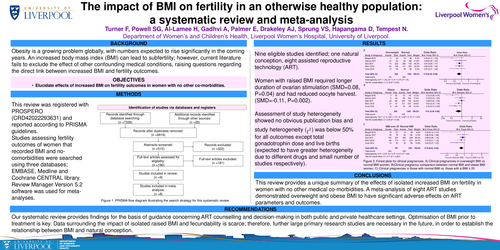
Nine eligible studies identified; one natural conception, eight assisted reproductive technology (ART).
Women with raised BMI required longer duration of ovarian stimulation (SMD=0.08, P=0.04) and had reduced oocyte harvest. (SMD=-0.11, P=0.002).
Assessment of study heterogeneity showed no obvious publication bias and study heterogeneity (I^2) was below 50% for all outcomes except total gonadotrophin dose and live births (expected to have greater heterogeneity due to different drugs and small number of studies respectively).
CONCLUSIONS
This review provides a unique summary of the effects of isolated increased BMI on fertility in women with no other medical co-morbidities. A meta-analysis of eight ART studies demonstrated overweight and obese BMI to have significant adverse effects on ART parameters and outcomes.
RECOMMENDATIONS
Our systematic review provides findings for the basis of guidance concerning ART counselling and decision-making in both public and private healthcare settings. Optimisation of BMI prior to treatment is key. Data surrounding the impact of isolated raised BMI and fecundability is scarce; therefore, further large primary research studies are necessary in the future, in order to establish the relationship between BMI and natural conception.