1,830 posters, 67 videos, 75 audios, 29 topics, 22 sessions, 4,727 authors, 1,697 institutions
ePostersLive by SciGen Technologies S.A. All rights reserved.
RCOG World Congress 2023
June 12 - 14, 2023 | London, UK

PP.0070
Biologic drug use in pregnancy. A Clinical review of the literature.
Poster Presenter
Authors
Affiliations
Part of Topic
Maternal Medicine
Biologic drug use in pregnancy. A Clinical review of literature.
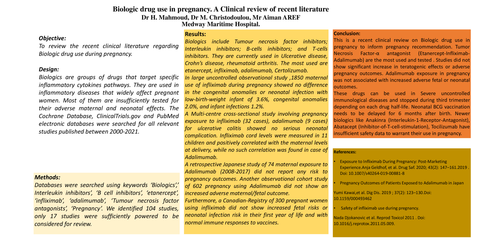
Objective:
To review the recent clinical literature regarding Biologic drug use during pregnancy.
Design:
Biologics are groups of drugs that target specific inflammatory cytokines pathways. They are used in inflammatory diseases that widely affect pregnant women. Most of them are insufficiently tested for their adverse maternal and neonatal effects. The Cochrane Database, ClinicalTrials.gov and PubMed electronic databases were searched for all relevant studies published between 2000-2021.
Methods:
Databases were searched using keywords ‘Biologics’,’ Interleukin inhibitors’, ‘B cell inhibitors’, ‘etanercept’, ‘infliximab’, ‘adalimumab’, ‘Tumour necrosis factor antagonists’, ‘Pregnancy’. We identified 104 studies, only 17 studies were sufficiently powered to be considered for review.
Results:
Biologics include Tumour necrosis factor inhibitors; Interleukin inhibitors; B-cells inhibitors; and T-cells inhibitors. They are currently used in Ulcerative disease, Crohn’s disease, rheumatoid arthritis. The most used are etanercept, infliximab, adalimumab, Certolizumab.
In large uncontrolled observational study ,1850 maternal use of infliximab during pregnancy showed no difference in the congenital anomalies or neonatal infection with low-birth-weight infant of 3.6%, congenital anomalies 2.0%, and infant infections 1.2%.
A Multi-centre cross-sectional study involving pregnancy exposure to infliximab (32 cases), adalimumab (9 cases) for ulcerative colitis showed no serious neonatal complication. Infliximab cord levels were measured in 11 children and positively correlated with the maternal levels at delivery, while no such correlation was found in case of Adalimumab.
A retrospective Japanese study of 74 maternal exposure to Adalimumab (2008-2017) did not report any risk to pregnancy outcomes. Another observational cohort study of 602 pregnancy using Adalimumab did not show an increased adverse maternal/fetal outcome.
Furthermore, a Canadian-Registry of 300 pregnant women using infliximab did not show increased fetal risks or neonatal infection risk in their first year of life and with normal immune responses to vaccines.
Conclusion:
This is the largest clinical review on Biologic drug use in pregnancy to inform pregnancy recommendation. Tumour Necrosis Factor-α antagonist (Etanercept-Infliximab-Adalimumab) are the most used. Studies did not show significant increase in teratogenic effects or adverse pregnancy outcomes. Adalimumab exposure in pregnancy was not associated with increased adverse fetal or neonatal outcomes.
These drugs can be used in Severe uncontrolled immunological diseases and stopped during third trimester depending on each drug half-life. Neonatal BCG vaccination needs to be delayed for 6 months after birth. Newer biologics like Anakinra (Interleukin-1-Receptor-Antagonist), Abatacept (Inhibitor-of-T-cell-stimulation), Tocilizumab have insufficient safety data to warrant their use in pregnancy.
References:
- Exposure to Infliximab During Pregnancy: Post-Marketing Experience. Anja Geldhof, et al. Drug Saf. 2020; 43(2): 147–161.2019. Doi: 10.1007/s40264-019-00881-8
- Pregnancy Outcomes of Patients Exposed to Adalimumab in Japan.Yumi Kawai,et al. Dig Dis. 2019 ; 37(2): 123–130.Doi: 10.1159/000493462
- Safety of infliximab use during pregnancy.Nada Djokanovic et al. Reprod Toxicol 2011 . Doi: 10.1016/j.reprotox.2011.05.009.
- Pregnancy Outcomes of Patients Exposed to Adalimumab in Japan.Yumi Kawai,et al. Dig Dis. 2019 ; 37(2): 123–130. Doi: 10.1159/000493462
- Biologic therapies during pregnancy in women with inflammatory bowel disease: safety profile, management, and outcomes. Moccia F, Ingravallo G, Fries W. Expert Opinion on Biological Therapy, 2019.DOI: 10.1080/14712598.2019.1656734