1,830 posters, 67 videos, 75 audios, 29 topics, 22 sessions, 4,727 authors, 1,697 institutions
ePostersLive by SciGen Technologies S.A. All rights reserved.
RCOG World Congress 2023
June 12 - 14, 2023 | London, UK

PP.0068
An NHS trust audit on accuracy of maternity venous thromboembolism risk assessment
Poster Presenter
Part of Topic
Maternal Medicine
AN NHS TRUST AUDIT ON ACCURACY OF MATERNITY VENOUS THROMBOEMBOLISM RISK ASSESSMENT
Background
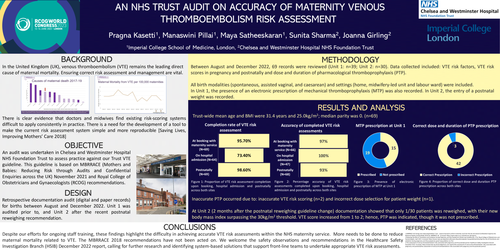
In the United Kingdom (UK), venous thromboembolism (VTE) remains the leading direct cause of maternal mortality. Ensuring correct risk assessment and management are vital.
There is clear evidence that doctors and midwives find existing risk-scoring systems difficult to apply consistently in practice. There is a need for the development of a tool to make the current risk assessment system simple and more reproducible [Saving Lives, Improving Mothers’ Care 2018]
Objective
An audit was undertaken in Chelsea and Westminster Hospital NHS Foundation Trust to assess practice against our Trust VTE guideline. This guideline is based on MBRRACE (Mothers and Babies: Reducing Risk through Audits and Confidential Enquiries across the UK) November 2021 and Royal College of Obstetricians and Gynaecologists (RCOG) recommendations.
Design
Retrospective documentation audit (digital and paper records) for births between August and December 2022. Unit 1 was audited prior to, and Unit 2 after the recent postnatal reweighing recommendation.
Method
Between August and December 2022, 69 records were reviewed (Unit 1: n=39; Unit 2: n=30). Data collected included: VTE risk factors, VTE risk scores in pregnancy and postnatally, and dose and duration of pharmacological thromboprophylaxis (PTP).
All birth modalities (spontaneous, assisted vaginal, and caesarean) and settings (home, midwifery-led unit and labour ward) were included.
In Unit 1, the presence of an electronic prescription of mechanical thromboprophylaxis (MTP) was also recorded. In Unit 2, the entry of a postnatal weight was recorded.
Results
Trust-wide mean age and BMI were 31.4 years and 25.0kg/m2; median parity was 0. (n=69)
Inaccurate PTP occurred due to: inaccurate VTE risk scoring (n=2) and incorrect dose selection for patient weight (n=1).
At Unit 2 (2 months after the postnatal reweighing guideline change) documentation showed that only 1/30 patients was reweighed, with their new body mass index surpassing the 30kg/m2 threshold. VTE score increased from 1 to 2; hence, PTP was indicated, though it was not prescribed
Conclusions
Despite our efforts for ongoing staff training, these findings highlight the difficulty in achieving accurate VTE risk assessments within the NHS maternity service. More needs to be done to reduce maternal mortality related to VTE. The MBRRACE 2018 recommendations have not been acted on. We welcome the safety observations and recommendations in the Healthcare Safety Investigation Branch (HSIB) December 2022 report, calling for further research and identifying system-based solutions that support front-line teams to undertake appropriate VTE risk assessments.
References
1.MBRRACE-UK Saving Lives Improving Mothers' Care - Lessons learned to inform maternity care from the UK and Ireland Confidential Enquiries into Maternal Deaths and Morbidity 2018-20. MBRRACE-UK. Accessed: https://www.npeu.ox.ac.uk/mbrrace-uk/reports
2.Reducing the Risk of Thrombosis and Embolism during Pregnancy and the Puerperium (Green-top Guideline No. 37a). Royal College of Obstetricians and Gynaecologists. April 2015. Accessed: https://www.rcog.org.uk/guidance/browse-all-guidance/green-top-guidelines/reducing-the-risk-of-thrombosis-andembolism-during-pregnancy-and-the-puerperium-green-top-guideline-no-37a/
3.The assessment of venous thromboembolism risks associated with pregnancy and the postnatal period. Healthcare Safety Investigation Branch. December 2022. Accessed: https://www.hsib.org.uk/investigations-and-reports/the-assessment-of-venous-thromboembolism-risks-associated-withpregnancy-and-postnatal/the-assessment-of-venous-thromboembolism-risks-associated-with-pregnancy-and-the-postnatal-period/