1,830 posters, 67 videos, 75 audios, 29 topics, 22 sessions, 4,727 authors, 1,697 institutions
ePostersLive by SciGen Technologies S.A. All rights reserved.
RCOG World Congress 2023
June 12 - 14, 2023 | London, UK

PP.0064
Implementing guidelines: Response to optimised treatment of iron deficiency anaemia in pregnancy.
Poster Presenter
Part of Topic
Hot Topics (Emerging research/issues) in Obstetrics
Implementing guidelines: Response to optimised treatment of iron deficiency anaemia in pregnancy. PP.0064
David Churchill*1,4, Hind Ali 4, Samaher Sweity3, Dianne Bautiste3, Laura Devison4, Julia Icke4, Simon Stanworth 2, 3. 1Research Institute in Healthcare Science, University of Wolverhampton, 2Clinical haematology, Oxford University Hospitals NHS Foundation Trust, 3 NHS Blood and Transplant, Oxford, 4 Dept of Obstetrics, The Royal Wolverhampton NHS Trust, Wolverhampton, United Kingdom.
Background: Iron deficiency anaemia(IDA) affects 30% of pregnant women in the antenatal period and 20% postnatally. It causes symptoms of malaise, lethargy and shortness of breath, and is associated with adverse events including low birth weight, preterm birth, postpartum haemorrhage, postnatal depression, stillbirth and neonatal death,. Infants of mothers who have IDA during pregnancy have neurocognitive impairment lasting into childhood. Studies have highlighted the ineffectiveness of current treatment strategies, which have been put down to the side effects and poor adherence. This may be part of the answer, but it requires further exploration.
Objectives: To optimize the management of IDA in pregnancy according to the British Society of Haematology (BSH) Guidelines and assess the clinical and haematologicalresponses.
Aims:
Methods:
A prospective cohort study of pregnant women diagnosed with IDA up to 36+6 weeks gestation. Women were seen in a dedicated clinic for management. The BSH 2012 guidelines for the management of anaemia during pregnancy were followed. Treatment was with ferrous sulphate 200mg tds or bd.
Data were collected on response rates, changes in haematological measures, adherence, side effects, and quality of life scores.
Two definitions of response were applied. 1) The first, as defined by BSH – a 10g/L increase in Hb 2 weeks after starting treatment (HRes) and 2) in order to account for the haemodilution effect of pregnancy ORes which was a 10g/L increase in Hb and/or normalization of the Hb adjusted for gestation. The tools used to collect information on side effects and quality of life were; frequency and severity of symptoms tool adapted from Foxcroft 2013, side effects and tolerability from a tool adapted by Peirara 2014, WHO QoL, Wellbeing in Pregnancy (Alderdice et al 2017)
Results:
98 women were enrolled in the study and 87 completed follow up.
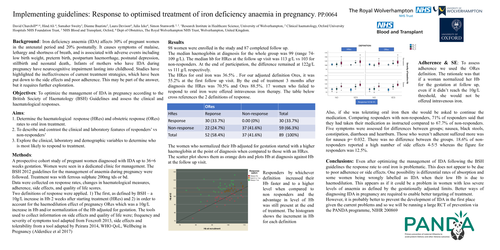
The median haemoglobin at diagnosis for the whole group was 99 (range 74-109 g/L). The median hb for HRes at the follow up visit was 113 g/L vs 103 for non-responders. At the end of participation, the difference remained at 122g/L vs 111 g/L respectively.
The HRes for oral iron was 36.5% . For our adjusted definition Ores, it was 55.2% at the first follow up visit. By the end of treatment 3 months after diagnosis the HRes was 70.5% and Ores 88.5%. 17 women who failed to respond to oral iron were offered intravenous iron therapy. The table below cross references the 2 definitions of response.
The women who normalized their Hb adjusted for gestation started with a higher haemoglobin at the point of diagnosis when compared to those with an HRes. The scatter plot shows them as orange dots and plots Hb at diagnosis against Hb at the follow up visit.
Responders by whichever definition increased their Hb faster and to a higher level when compared to non responders and the advantage in level of Hb was still present at the end of treatment. The histogram shows the increment in Hb for each definition
Adherence & SE: To assess adherence we used the ORes definition. The rationale was that if a woman normalized her Hb for the gestation at follow up, even if it didn’t reach the 10g/L threshold, she would not be offered intravenous iron.
Also, if she was tolerating oral iron then she would be asked to continue the medication. Comparing responders with non-responders, 71% of responders said that they had taken their medication as instructed compared to 67.7% of non-responders. Five symptoms were assessed for differences between groups; nausea, black stools, constipation, diarrhoea and heartburn. Those who weren’t adherent suffered more was for nausea p= 0.032. There was no difference between the groups. 18.6% of non-responders reported a high number of side effects 4-5/5 whereas the figure for responders was 12.5%.
Conclusions: Even after optimizing the management of IDA following the BSH guidelines the response rate to oral iron is problematic. This does not appear to be due to poor adherence or side effects. One possibility is differential rates of absorption and some women being wrongly labelled as IDA when their low Hb is due to haemodilution. This appears as if it could be a problem in women with less severe levels of anaemia as defined by the gestationally adjusted limits. Better ways of diagnosing IDA in pregnancy are required to enable better targeting of treatment.
However, it is probably better to prevent the development of IDA in the first place given the current problems and so we will be running a large RCT of prevention via the PANDA programme, NIHR 200869