1,830 posters, 67 videos, 75 audios, 29 topics, 22 sessions, 4,727 authors, 1,697 institutions
ePostersLive by SciGen Technologies S.A. All rights reserved.
RCOG World Congress 2023
June 12 - 14, 2023 | London, UK

PP.0058
The Lived Experience of Pregnancy and Birth for Rape Survivors: Practice Implications
Poster Presenter
Authors
Affiliations
Part of Topic
Hot Topics (Emerging research/issues) in Obstetrics
The Lived Experience of Pregnancy and Birth for Rape Survivors: Practice Implications
Dr Rebecca Lissmann
Background
Method
Results
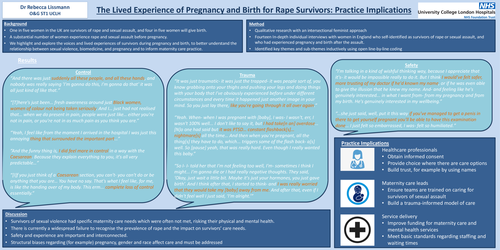
Control
“And there was just suddenly all these people, and all these hands, and nobody was really saying 'I'm gonna do this, I'm gonna do that' it was all just kind of like that.”
“[T]here's just been… fresh awareness around just Black women, women of colour not being taken seriously. And I… just had not realised that… when we do present in pain, people were just like… either you're not in pain, or you're not in as much pain as you think you are.”
“Yeah, I feel like from the moment I arrived in the hospital I was just this annoying thing that surrounded the important part…”
“And the funny thing is, I did feel more in control in a way with the Caesarean. Because they explain everything to you, it's all very predictable…”
“[I]f you just think of a Caesareansection, you can't- you can't do or be anything that you are… You have no say. That's what I feel like, for me, is like the handing over of my body. This erm... complete loss of control essentially.”
Trauma
“It was just traumatic- it was just the trapped- it was people sort of, you know grabbing onto your thighs and pushing your legs and doing things with your body that I've obviously experienced before under different circumstances and every time it happened just another image in your mind. So you just lay there, like you're going through it all over again.”
“Yeah. When- when I was pregnant with [baby], I was- I wasn't, err, I wasn't 100% well... I don't like to say it, but I had take[n an] overdose… [N]o one had said but it was PTSD… constant flashback[s]… nightmare[s] all the time… And then when you're pregnant, all the thing[s] they have to do, which... triggers some of the flash back- a[s] well. So [pause] yeah, that was really hard. Even though I really wanted this baby.”
“So I- I- told her that I'm not feeling too well, I'm- sometimes I think I might... I'm gonna die or I had really negative thoughts. They said, ‘Okay, just wait a little bit. Maybe it's just your hormones, you just gave birth’. And I think after that, I started to think- and I was really worried that they would take my [baby] away from me. And after that, even if I didn't feel well I just said, ‘I'm alright.’”
Safety
“I'm talking in a kind of wishful thinking way, because I appreciate that it's- it would be impossible really to do it. But I think I would've felt safer, more trusting of my doctor if he'd known my name, or if he was even able to give the illusion that he knew my name. And- and feeling like he's genuinely interested... in what I want from- from my pregnancy and from my birth. He's genuinely interested in my wellbeing.”
“…she just said, well, put it this way if you've managed to get a penis in there to get yourself pregnant you'll be able to have this examination done… I just felt so embarrassed, I was- felt so humiliated.”
Discussion
Practice Implications
Healthcare professionals
Maternity care leads
Service delivery