1,830 posters, 67 videos, 75 audios, 29 topics, 22 sessions, 4,727 authors, 1,697 institutions
ePostersLive by SciGen Technologies S.A. All rights reserved.
RCOG World Congress 2023
June 12 - 14, 2023 | London, UK

PP.0053
Effects of doubling oxytocin incremental intervals for induction of labour at term
Poster Presenter
Part of Topic
Labour Ward Management
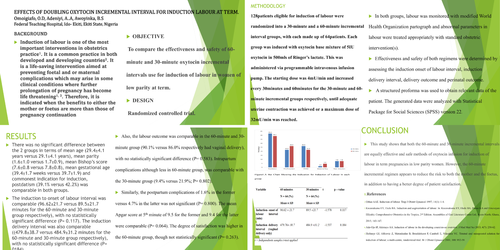
BACKGROUND: The importance of induction of labour in obstetric practice cannot be over emphasized. It is indicated in maternal and foetal conditions in which further continuation of the pregnancy can lead to maternal, foetal or foetomaternal complications. The other alternative is caesarean section, which is however more expensive and associated with more complications, delayed mother and new born bonding and longer stay in hospital.
Oxytocin is a common and generally very successful drug used in labour induction, with various oxytocin regimens being recommended. However, as a result of its cost and associated complications, efforts are being geared towards finding the minimal effective dose associated with lesser complications.
OBJECTIVE: To compare the effectiveness and safety of 60-minute and 30-minute oxytocin incremental intervals use for induction of labour in women of low parity at term.
METHODOLOGY: One hundred and twenty eight patients eligible for induction of labour were randomized into a 30-minute incremental interval group and a 60-minute incremental interval group, with each made up of sixty four patients. Each group were induced with oxytocin base mixture of 5IU oxytocin in 500mls of Ringer’s lactate. This was administered via programmable intravenous infusion pump. The starting dose was 4mU/min (8drops/min) and increased every 30 minutes and every 60 minutes for the 30-minute incremental interval group and 60-minute incremental group respectively, until adequate uterine contraction was achieved or a maximum dose of 32mU/min (64drops/ min) was reached.
In both groups, labour was monitored with modified World Health Organization partograph to detect any abnormality in labour progression. Abnormal parameters in labour were treated in accordance with standard obstetric intervention(s) as appropriate.
Effectiveness and safety of both regimens were determined by assessing the induction onset of labour interval, induction delivery interval, delivery outcome and perinatal outcome.
A structured proforma was used to obtain relevant data of the patient. The generated data were analyzed with Statistical Package for Social Sciences (SPSS) version 22.
RESULTS: There was no significant difference between the 2 groups in terms of mean age (29.4±4.1 years versus 29.1±4.1 years), mean parity (1.6±1.0 versus 1.7±0.9), mean Bishop’s score (7.6±0.8 versus 7.8±0.8), mean gestational age (39.4±1.7 weeks versus 39.7±1.9) and commonest indication for induction, postdatism (39.1% versus 42.2%) was comparable in both groups.
The induction to onset of labour interval was comparable (96.62±21.7 versus 89.5±21.7 minutes for the 60-minute and 30-minute group respectively), with no statistically significant difference (P= 0.117). The induction delivery interval was also comparable ((479.8±38.7 versus 484.9±31.2 minutes for the 60-minute and 30-minute group respectively), with no statistically significant difference (P= 0184)
Also, the labour outcome was comparable in the 60-minute and 30-minute group (90.1% versus 86.0% respectively had vaginal delivery), with no statistically significant difference (P= 0.583). Intrapartum complications although less in 60-minute group, was comparable with the 30-minute group (9.4% versus 21.9%; P= 0.802). Similarly, the postpartum complications of 1.6% in the former versus 4.7% in the latter was not significant (P= 0.800). The mean Apgar score at 5th minute of 9.5 for the former and 9.4 for the latter were comparable (P= 0.064). The degree of satisfaction was higher in the 60-minute group, though not statistically significant (P= 0.263).
CONCLUSION: 60-minute oxytocin incremental interval appears to be a good alternative to the more popular 30-minute oxytocin incremental interval for induction of labour. It reduces the intrapartum and postpartum foetomaternal risks.
STUDY STRENGTH: The study being a randomized controlled trial reduced