1,830 posters, 67 videos, 75 audios, 29 topics, 22 sessions, 4,727 authors, 1,697 institutions
ePostersLive by SciGen Technologies S.A. All rights reserved.
RCOG World Congress 2023
June 12 - 14, 2023 | London, UK

PP.0036
Systematic Reviews of Risks of Thrombosis and Bleeding in Gynecologic Non-Cancer Surgery
Poster Presenter
Authors
Lauri I. Lavikainen, Gordon H. Gyatt, Ilkka E.J. Kalliala, Rufus Cartwright, Anna L. Luomaranta, Robin W. M. Vernooij, Riikka M. Tähtinen, Borna Tadayon Najafabadi, Tino Singh, Negar Pourjamal, Sanna M. Oksjoki, Nadina Khamani, Päivi K. Karjalainen, Kirsi M. Joronen, Matthew L. Izett-Kay, Jari Haukka, Alex L.E. Halme, Fang Zhou Ge, Päivi J. Galambosi, P.J. Devereaux, Jovita L. Cárdenas, Rachel J. Couban, Karoliina M. Aro, Riikka L. Aaltonen, Kari A. O. Tikkinen
Affiliations
Faculty of Medicine, University of Helsinki, Helsinki, Finland, Department of Health Research Methods, Evidence and Impact, McMaster University, Department of Obstetrics and Gynecology, University of Helsinki and Helsinki University Hospital, Departments of Gynaecology and Gender Affirmation Surgery, Chelsea and Westminster NHS Foundation Trust, Julius Center for Health Sciences and Primary Care, University Medical Center Utrecht, Utrecht University, Department of Obstetrics and Gynecology, Tampere University and Tampere University Hospital, Faculty of Health Sciences, University of Eastern Finland, Felicitas Mehiläinen Turku, Department of Urology, University of Helsinki and Helsinki University Hospital, Department of Obstetrics and Gynecology, Central Finland Central Hospital, Department of Obstetrics and Gynecology, Turku University Hospital and University of Turku, Urogynaecology Department, The John Radcliffe Hospital, Oxford University Hospitals, Faculty of Medicine and Health Technology , Tampere University, Michael G. DeGroote School of Medicine, McMaster University, National Center for Health Technology Excellence (CENETEC) Direction of Health Technologies assessment, Department of Anesthesia, McMaster University
Part of Topic
Benign Gynaecology
Introduction and Background
Pharmacological thromboprophylaxis involves balancing a lower risk of venous thromboembolism (VTE)against ahigher risk of bleeding, a trade-off that critically depends on VTE and bleeding risks in the absence of prophylaxis (baseline risk) Baseline risks likely vary widely between procedures, but their magnitude remains uncertain.
Atleast in part due to this remaining uncertainty regarding baseline risk, thromboprophylaxis practices vary substantially within and between countries in benign gynecologic surgery.
Methods
We conducted comprehensives earches on Embase, MEDLINE, Web of Science, and Google Scholar.
We identified observational studies reporting symptomatic VTE or major bleeding (bleeding requiring reoperation,bleeding leading to transfusion or Hb<70g/L) after gynecologic non-cancer surgery procedures.
In addition, we performed separate searches for randomized trials addressing effects of thromboprophylaxis and conducted a web-based survey on thromboprophylaxis practice.
We adjusted the reported risk estimates for thromboprophylaxis and length of follow-upto determine baseline cumulative incidence at 4 weeks post-surgery for each procedure.
We stratified VTE risk by patient risk factors as low(no patient risk factors), medium (age>75years, or BMI>35, or VTEin a1 st degree relative), or high (any combination or personal VTE history).
We excluded high risk of bias articles, when possible, and used the GRADE approach to rate evidence certainty.
Results
We identified 7556 titles and abstracts, of which 131 studies proved eligible, reporting on 50 gynecologic non-cancer surgery procedures.
Evidence certainty was generally moderate or low for VTE and low or very low for bleeding.
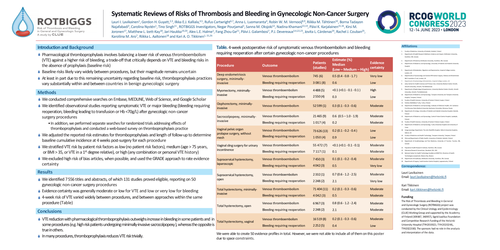
4-week risk of VTE varied widely between procedures, and between approaches within the same procedure(Table).
Conclusions
VTE reduction with pharmacological thromboprophylaxis outweighs increase in bleeding in some patients and in some procedures (e.g.high risk patients undergoing minimally-invasive sacrocolpopexy),where as the opposite is true in others.
In many procedures,thromboprophylaxis reduces VTE risk trivially.