1,830 posters, 67 videos, 75 audios, 29 topics, 22 sessions, 4,727 authors, 1,697 institutions
ePostersLive by SciGen Technologies S.A. All rights reserved.
RCOG World Congress 2023
June 12 - 14, 2023 | London, UK

PP.0035
Planned vs actual mode of delivery of twins and associated risk factors
Poster Presenter
Part of Topic
Hot Topics (Emerging research/issues) in Obstetrics
Video
Best laid plans
Risk factors associated with the planned and actual mode of delivery of twins
Background
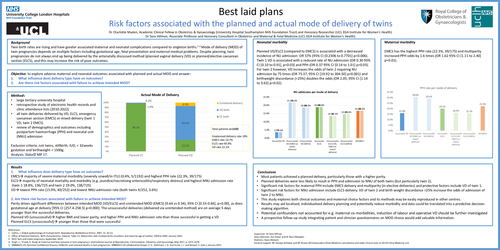
Twin birth rates are rising and have greater associated maternal and neonatal complications compared to singleton births.1-5 Mode of delivery (MOD) of twin pregnancies depends on multiple factors including gestational age, fetal presentation and maternal medical problems. Despite planning, twin pregnancies do not always end up being delivered by the antenatally discussed method (planned vaginal delivery (VD) or planned/elective caesarean section (ELCS), and this may increase the risk of poor outcomes.
Objective: to explore adverse maternal and neonatal outcomes associated with planned and actual MOD and answer:
Methods
Exclusion criteria: not twins, stillbirth, IUD, < 32weeks gestation and birthweight < 1500g.
Analysis: Stata© MP 17.
Results
EMCS: majority of severe maternal morbidity (severely unwell/in ITU) (0.4%, 5/1192) and highest PPH rate (22.3%, 39/175)
ELCS: majority of neonatal mortality and morbidity (e.g. jaundice/necrotising enterocolitis/respiratory distress) and highest NNU admission rate
(twin 1 18.8%, 136/725 and twin 2 19.0%, 138/725)
VDà lowest PPH rate (15.9%, 40/252) and lowest NNU admission rate (both twins 9/252, 3.6%)
2. Are there risk factors associated with failure to achieve intended MOD?
Parity drives significant differences between intended MOD (VD/ELCS) and unintended MOD (EMCS) [0.64 vs 0.34), 95% CI [0.53-0.66], p=0.00], as does gestational age at delivery [95% CI [257.4-258.5] p=0.000]. The unsuccessful deliveries (delivered via unintended method) are on average 5 days younger than the successful deliveries.
Planned VD (unsuccessful): higher BMI and lower parity, and higher PPH and NNU admission rate than those successful in getting a VD
Planned ELCS (unsuccessful): younger than those that were successful
Neonatal morbidity
Planned VD/ELCS (compared to EMCS) is associated with a decreased incidence of NU admission: OR 57% (95% CI (0.2306 to 0.7701) p=0.006).
Twin 1 VD is associated with a reduced rate of NU admission (OR 0.30 95% CI [0.10 to 0.91], p=0.03) and PPH (OR 0.37 95% CI [0.14 to 1.01] p=0.05).
For twin 2 however, VD increases the odds of twin 2 requiring NU admission by 75 times (OR 75.37, 95% CI [19.92 to 304.50] p<0.001) and birthweight discordance (>25%) doubles the odds (OR 2.05, 95% CI [1.14 to 3.63] p=0.02).
Maternal morbidity
EMCS has the highest PPH rate (22.3%, 39/175) and multiparity increased PPH odds by 1.6 times (OR 1.62 95% CI [1.11 to 2.40] p=0.01).
Conclusions