1,830 posters, 67 videos, 75 audios, 29 topics, 22 sessions, 4,727 authors, 1,697 institutions
ePostersLive by SciGen Technologies S.A. All rights reserved.
RCOG World Congress 2023
June 12 - 14, 2023 | London, UK

EP.0168
PREGNANCY OUTCOME IN GESTATIONAL DIABETIC WISTAR RATS TREATED WITH MANGIFERA INDICA.
Part of Topic
Maternal Medicine
PREGNANCY OUTCOME IN GESTATIONAL DIABETIC WISTAR RATS TREATED WITH MANGIFERA INDICA
Dr Hauwa Umar Shuaib - Department of Obstetrics and Gynaecology, Ahmadu Bello University, Zaria, Nigeria
Dr Zainab Ahmed Datti, Professor Sani Malami - Bayero University, kano, Nigeria
INTRODUCTION
Despite the proven hypoglycaemic property of Mangifera indica (mango leaves) in animal studies and safety in normal pregnancy, there is paucity of literature on its use in gestational diabetes mellitus (GDM)
OBJECTIVE
To assess the hypoglycaemic effect of Mangifera indica leaves extract (MILE) in GDM
Design: A case control study that compared GDM treated with MILE to controls
METHOD
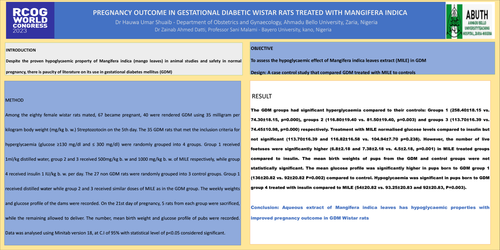
Among the eighty female wistar rats mated, 67 became pregnant, 40 were rendered GDM using 35 milligram per kilogram body weight (mg/kg b. w.) Streptozotocin on the 5th day. The 35 GDM rats that met the inclusion criteria for hyperglycaemia (glucose ≥130 mg/dl and ≤ 300 mg/dl) were randomly grouped into 4 groups. Group 1 received 1ml/kg distilled water, group 2 and 3 received 500mg/kg b. w and 1000 mg/kg b. w. of MILE respectively, while group 4 received insulin 1 IU/kg b. w. per day. The 27 non GDM rats were randomly grouped into 3 control groups. Group 1 received distilled water while group 2 and 3 received similar doses of MILE as in the GDM group. The weekly weights and glucose profile of the dams were recorded. On the 21st day of pregnancy, 5 rats from each group were sacrificed, while the remaining allowed to deliver. The number, mean birth weight and glucose profile of pubs were recorded. Data was analysed using Minitab version 18, at C.I of 95% with statistical level of p<0.05 considered significant.
The GDM groups had significant hyperglycaemia compared to their controls: Groups 1 (258.40±18.15 vs. 74.30±18.15, p=0.000), groups 2 (116.80±19.40 vs. 81.50±19.40, p=0.003) and groups 3 (113.70±16.39 vs. 74.45±10.98, p=0.000) respectively. Treatment with MILE normalised glucose levels compared to insulin but not significant (113.70±16.39 and 116.82±16.58 vs. 104.94±7.70 p=0.238). However, the number of live foetuses were significantly higher (6.8±2.18 and 7.38±2.18 vs. 4.5±2.18, p=0.001) in MILE treated groups compared to insulin. The mean birth weights of pups from the GDM and control groups were not statistically significant. The mean glucose profile was significantly higher in pups born to GDM group 1 (136±20.82 vs. 92±20.82 P=0.002) compared to control. Hypoglycaemia was significant in pups born to GDM group 4 treated with insulin compared to MILE (54±20.82 vs. 93.25±20.83 and 92±20.83, P=0.003).
Conclusion: Aqueous extract of Mangifera indica leaves has hypoglycaemic properties with improved pregnancy outcome in GDM Wistar rats