1,830 posters, 67 videos, 75 audios, 29 topics, 22 sessions, 4,727 authors, 1,697 institutions
ePostersLive by SciGen Technologies S.A. All rights reserved.
RCOG World Congress 2023
June 12 - 14, 2023 | London, UK

EP.0016
Review of Multidisciplinary care of Women with Epilepsy in Pregnancy
Poster Presenter
Authors
Alexander Loitz, Erika Campbell, Jerilyn Lee, Priyanka Surana, Binita Pande, Pauline Smith
Affiliations
Part of Topic
High Risk Pregnancy
Review of Multidisciplinary care of Women with Epilepsy in Pregnancy
Abstract
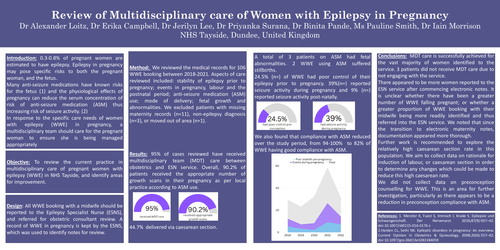
Objective: To review the current practice in multidisciplinary care of pregnant women with epilepsy (WWE) in NHS Tayside, and identify areas for improvement.
Design: All WWE booking with a midwife should be reported to the Epilepsy Specialist Nurse (ESNS), and referred for obstetric consultant review. A record of WWE in pregnancy is kept by the ESNS, which was used to identify notes for review.
Method: We reviewed the medical records for 106 WWE booking between 2018-2021. Aspects of care reviewed included: stability of epilepsy prior to pregnancy; events in pregnancy, labour and the postnatal period; anti-seizure medication (ASM) use; mode of delivery; fetal growth and abnormalities. We excluded patients with missing maternity records (n=11), non-epilepsy diagnosis (n=3), or moved out of area (n=1).
Results: 95% of cases reviewed have received multidisciplinary team (MDT) care between obstetrics and ESN service. Overall, 90.2% of patients received the appropriate number of growth scans in their pregnancy as per local practice according to ASM use. 44.7% delivered via caesarean section.
A total of 3 patients on ASM had fetal abnormalities. 2 WWE using ASM suffered stillbirths.
24.5% of WWE had poor control of their epilepsy prior to pregnancy. 39% reported seizure activity during pregnancy and 9% reported seizure activity postnatally.
We also found that compliance with ASM reduced over the study period, from 94-100% to 82% of WWE having good compliance with ASM.
Conclusions: MDT care is successfully achieved for the vast majority of women identified to the service. 3 patients did not receive MDT care due to not engaging with the service.
There appeared to be more women reported to the ESN service after commencing electronic notes. It is unclear whether there have been a greater number of WWE falling pregnant; or whether a greater proportion of WWE booking with their midwife being more readily identified and thus referred into the ESN service. We noted that since the transition to electronic maternity notes, documentation appeared more thorough.
Further work is recommended to explore the relatively high caesarean section rate in this population. We aim to collect data on rationale for induction of labour, or caesarean section in order to determine any changes which could be made to reduce this high caesarean rate.
We did not collect data on preconception counselling for WWE. This is an area for further investigation, particularly as there appears to be a reduction in preconception compliance with ASM.