1,830 posters, 67 videos, 75 audios, 29 topics, 22 sessions, 4,727 authors, 1,697 institutions
ePostersLive by SciGen Technologies S.A. All rights reserved.
RCOG World Congress 2023
June 12 - 14, 2023 | London, UK

EP.0167
Locked-vs Unlocked-layer closure of the Caesarean incision in prevention of gynaecological symptoms
Poster Presenter
Authors
Affiliations
Part of Topic
Hot Topics (Emerging research/issues) in Obstetrics
Video
Title
Locked-vs Unlocked-layer closure of the Caesarean incision in prevention of gynaecological symptoms
Abstract
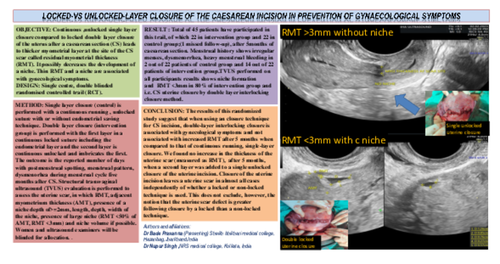
OBJECTIVE: Continous ,unlocked single layer closure compared to locked double layer closure of the uterus after a caesarean section (CS) leads to thicker myometrial layer at the site of the CS scar called residual myometrial thickness (RMT). It possibly decreases the development of a niche. Thin RMT and a niche are associated with gynecological symptoms.
DESIGN: Single centre, double blinded randomised controlled trail (RCT).
METHOD: Single layer closure (control) is performed with a continous running , unlocked suture with or without endometrial saving technique. Double layer closure (intervention group) is performed with the first layer in a continous locked suture including the endometrial layer and the second layer is continous unlocked and imbricates the first. The outcome is the reported number of days with postmenstrual spotting, menstrual pattern, dysmenorhea during menstrual cycle five months after CS. Structural transvaginal ultrasound (TVUS) evaluation is performed to assess the uterine scar, in which RMT, adjacent myometrium thickness (AMT), presence of a niche depth of>=2mm, length, depth, width of the niche, presence of large niche (RMT <50% of AMT, RMT <3mm) and niche volume if possible. Women and ultrasound examiners will be blinded for allocation.
RESULT : Total of 45 patients have participated in this trail, of which 22 in intervention group and 22 in control group;(1 missed followup), after 5months of caesarean section. Menstrual history shows irregular menses, dysmenorrhea, heavy menstrual bleeding in 2 out of 22 patients of control group and 14 out of 22 patients of intervention group.TVUS performed on all participants results shows niche formation and RMT <3mm in 80% of intervention group and i,e CS uterine closure by double layer interlocking closure method.
CONCLUSION: The results of this randomized study suggest that when using an closure technique for CS incision, double-layer interlocking closure is associated with gynecological symptoms and not associated with increased RMT after 5 months when compared to that of continous running, single-layer closure. We found no increase in the thickness of the uterine scar (measured as RMT), after 5 months, when a second layer was added to a single unlocked closure of the uterine incision. Closure of the uterine incision leaves a uterine scar in almost all cases independently of whether a locked or non-locked technique is used. This does not exclude, however, the notion that the uterine scar defect is greater following closure by a locked than a non-locked technique.
Keywords: uterine closure, menstrual problems
Categories
Hot Topics (Emerging research/issues) in Obstetrics
Authors and Affiliations
Dr Bade Prasanna (Presenting) prasannabade@gmail.com
Sheikh bhikhari medical college, hazaribag, India
Dr Nupur Singh nprsingh11@gmail.com
NRS medical college, kolkata, India