1,830 posters, 67 videos, 75 audios, 29 topics, 22 sessions, 4,727 authors, 1,697 institutions
ePostersLive by SciGen Technologies S.A. All rights reserved.
RCOG World Congress 2023
June 12 - 14, 2023 | London, UK

PP.0019
A National Survey of Clinician’s Opinions of Rotational Vaginal Births
Poster Presenter
Authors
Dawn Parris, Shireen Jaufuraully, Jeremy Opie, Dimitrios Siassakos, Raffaele Napolitano
Affiliations
Part of Topic
Labour Ward Management
A National Survey of Clinicians’ Opinions of Rotational Vaginal Births
Background:
Malposition of the fetal head, defined as occiput transverse (OT) or occiput posterior (OP) positions, occurs in approximately 5% of deliveries. At full cervical dilatation, fetal malposition is associated with an increased need for assisted delivery, and a higher risk of severe perineal trauma (1). Three different rotational methods can be employed to aid vaginal birth in cases of malposition in the second stage of labour. These methods are manual rotation, rotational ventouse, or (Kielland’s) rotational forceps.
At present, no randomised controlled trial has been completed to generate evidence comparing the outcomes of the three rotational methods. Standards of practice and competence in performing rotational deliveries have not been clarified. The variability in current practice may affect the accoucheur’s choice of rotational method.
Objectives:
Study Design:
Results:
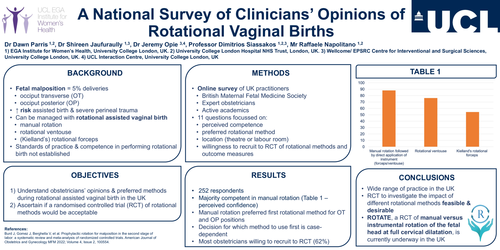
1) The majority of respondents were competent in manual rotation (88%)
2) Manual rotation is the preferred first rotational method in both OT and OP positions
3) The decision for which rotational method to use first is case-dependent
4) Over half of respondents do not routinely use intrapartum ultrasound (52%)
5) Most Obstetricians were willing to recruit to a RCT of manual vs instrumental rotation (62%)
Conclusion:
References:
1) Burd J, Gomez J, Berghella V, et al. Prophylactic rotation for malposition in the second stage of labor: a systematic review and meta-analysis of randomized controlled trials. American Journal of Obstetrics and Gynecology MFM 2022; Volume 4, Issue 2, 100554.