1,830 posters, 67 videos, 75 audios, 29 topics, 22 sessions, 4,727 authors, 1,697 institutions
ePostersLive by SciGen Technologies S.A. All rights reserved.
RCOG World Congress 2023
June 12 - 14, 2023 | London, UK

PP.0017
Late pregnancy tests to predict adverse outcomes related to placental dysfunction
Part of Topic
High Risk Pregnancy
Audio
Late pregnancy tests to predict adverse outcomes related to placental dysfunction
M Griffin1, H Miles1, L Slade2, A Suseeladevi1, A Heazell3, L Chappell4, D Lawlor1
1University of Bristol, Bristol, UK, 2University of Adelaide, Adelaide, Australia, 3University of Manchester, Manchester, UK, 4 King’s College London, London, UK
Objective
Placental dysfunction is key in the underlying pathological processes of many adverse pregnancy outcomes but most commonly pre-eclampsia, fetal growth restriction and stillbirth. The burden of these conditions occurs in the third trimester, therefore screening in mid to late pregnancy could facilitate prediction and targeted intervention aimed at reducing fetal and maternal morbidity and mortality.
Design
A systematic review and meta-analysis of late pregnancy (after 24 weeks’ gestation) tests in isolation or combination to predict outcomes including pre-eclampsia, stillbirth, or delivery of a growth restricted infant.
Methods
A protocol was published prior to data collection. EMBASE, MEDLINE, Cochrane CENTRAL, Web of Science, CINAHL, ISRCTN registry, UK Clinical Trials Gateway and WHO International Clinical Trials Portal were searched. All reports where the biomarker or ultrasound parameter was assessed before diagnosis of outcomes were included (RCT’s, nested prospective case-control, and cohort studies). All populations were included regardless of background risk, provided that a diagnosis of adverse pregnancy outcome had not yet been established. In studies where a 2 × 2 table could be extracted, the summary sensitivity and specificity with associated confidence intervals for individual tests were estimated using generalised linear mixed model approach. When sensitivity, specificity or 2x2 tables were not available, a meta-analysis of odds ratios provided a pooled estimate.
Results
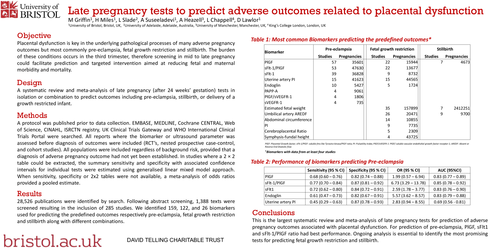
28,526 publications were identified by search. Following abstract screening, 1,388 texts were screened resulting in the inclusion of 285 studies. We identified 159, 122, and 26 biomarkers used for predicting the predefined outcomes respectively pre-eclampsia, fetal growth restriction and stillbirth along with different combinations.
Conclusions
This is the largest systematic review and meta-analysis of late pregnancy tests for prediction of adverse pregnancy outcomes associated with placental dysfunction. For prediction of pre-eclampsia, PlGF, sFlt1 and sFlt-1/PlGF ratio had best performance. Ongoing analysis is essential to identify the most promising tests for predicting fetal growth restriction and stillbirth.